Two premises

For political imagination, and for varieties of possibility

Open file no. 50, began 24 October 2023

Sa sandaling matutunan mo ang managinip nang lubusang gising,
na ibalanse ang kamalayan hindi sa talim ng pangangatwiran
ngunit sa dobleng katig ng katwiran at panaginip;
sa sandaling matutunan mo ito,
mabibitawan mo lamang ito sa oras na mabitawan mo
kung paano magisip.

Ursula K. Le Guin, Ang Salita Para Sa Daigdig Ay Gubat

Ang tunay na radikal ay ang gawing abot-kamay ang pag-asa,
hindi ang patunayan ang pagka-gipit.

Raymond Williams

As I wrap up my dissertation, and as I take part in conversations about energy transitions, alternative transnational economies and solidarities, and climate crisis responses other than war, I have found myself turning and returning to two premises. 

These arose as I came to my own understanding of how accumulation and class power had developed in the Philippines over five centuries of capitalist and colonial encounter.  

I am finding, again and again, that many analytical categories that had developed in response to realities found elsewhere have very limited usefulness here.  

This incongruency between concepts and realities is hinted at by the recurrent (evergreen?) mode of production debates within Philippine critical thought: is the Philippines a capitalist society, or is it semi-feudal, semi-colonial?  

Maybe it is both and neither: the debate continues because both descriptions help explain some features of the systems we wish to describe and resist. Yet neither does justice to life as it arises within, alongside, and outside these systems.  

If you and I agree, then we need to trace the reasons behind the poor conceptual fit.  

These two premises also arose out of wanting to make hope possible, not despair convincing. I want to react to the rigid radicalism and damage-based research that I keep running into—and keep reproducing, myself.

If the whole point of ‘theory’ is ‘seeing’, I would much rather now learn ways of seeing that open up rather than foreclose political imagination. Instead of learning how to see lack, I would rather learn how to see varieties of possibilityespecially in landscapes dismissed as wastelands.

If you and I agree, then we need to find a way to take part in conversations in a way that brings these abilities out—even among the most inflexible critical theory bores in our worlds.

Some rough, ongoing thoughts, under constant revision, shared here so we can pick up where we left off:

Continue reading “Two premises”
“De-Marcosification” and the rise of new urban rentiers:

On the unintended consequences of post-EDSA privatizations.

I will be presenting this paper at the The 5th Philippine Studies Conference in Japan organized by the Annual Philippine Studies Forum in Japan, on 27 November 2022. A version of this work was published on Philippine Studies: Historical and Ethnographic Viewpoints as The EDSA Republic as moral liquidator: Embedded origins, unintended consequences.

This paper revisits the lasting imprint left by privatizations after the EDSA Revolution on the development of capitalism in the Philippines in the early 21st century, with an emphasis on path-dependence, unintended consequences, and domestic technocratic and bureaucratic actors.

Focusing on the efforts of the Presidential Commission on Government Reorganization (PCGR) in the late 1980s, it re-evaluates how a specific understanding of the state’s role in the economy was developed through the reorganization of crony- and state-owned enterprises. It proposes that consequential features of privatization were not the outcome of an ideologically-coherent liberalization. Instead, they were part of a moralized “De-Marcosification” process: liquidating crony-owned or inefficient state investments to fund agrarian reform. This practice of linking proceeds from privatizations to specific policy objectives, in the form of “special accounts”, had since proliferated across the Philippine government. Key development and policy objectives were linked to the speed and constancy of asset liquidation, and became decisive in how privatizations in the 1990s and 2000s were implemented.

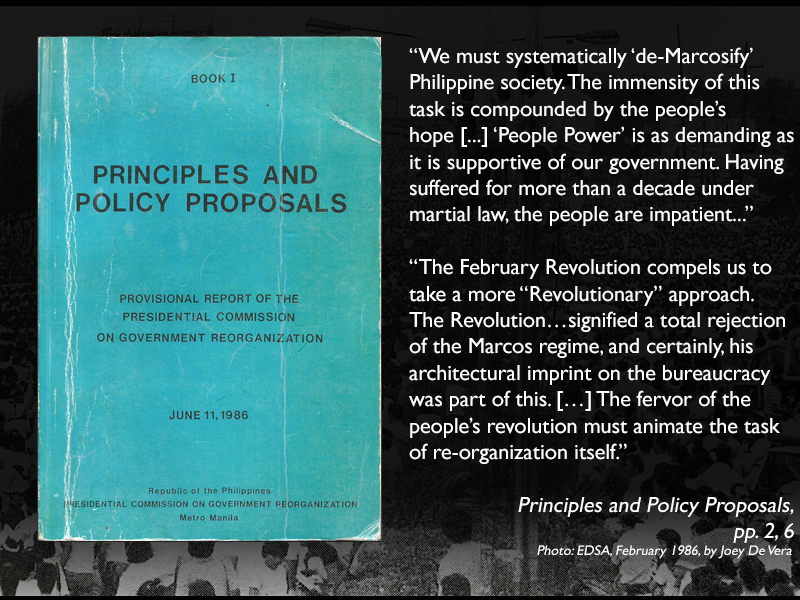
“We must systematically ‘de-Marcosify’ society.” From Principles and Policy Proposals, the provisional report of the Presidential Commission on Government Reorganization.
Continue reading ““De-Marcosification” and the rise of new urban rentiers:”

Measuring the Manila square meter

This essay originally appeared in the catalogue for the exhibition titledLiving Spaces: Hyperreal Estate and the Architecture of Dispossession“, curated by Alice Sarmiento. I wrote it in conversation with, and with thanks to, Alice Sarmiento, Andre Ortega, and Maria Khristine Alvarez.

Consider the average Manila billboard.

It is many times larger than the average Manila home. Perched above Manila’s hypertensive roads, it gets better breeze, sunlight, and sight lines than the average Manila home; its floodlights consume more power than several average Manila homes.

The visuals of the average Manila billboard are also larger than the average Manila life—especially when they peddle condominiums, those new average Manila homes for the 21st century. They feature models with impossibly white, impossibly smooth skins, living impossibly carefree lives of minutes-away convenience from the best that the city can offer, all under impossibly blue skies.

From a messaging point of view, the average Manila billboard needs to be larger than life. It must, after all, be heard above the jostle of shoulders, the knots in our backs, and the blare of last night’s death toll—all before we heave and lurch our way onto the next billboard.

It then needs to tell, within the limits set by 216 square meters,[1] convincing lies: small lies, about the life of grandeur possible within an eighteen square-meter unit,[2] about how the baked air takes your breath away, or about the mysterious dues and fees that await.

Fig. 1. About twelve 18m2 Manila studio units can fit within a 216m2 Manila billboard.

Continue reading “Measuring the Manila square meter”

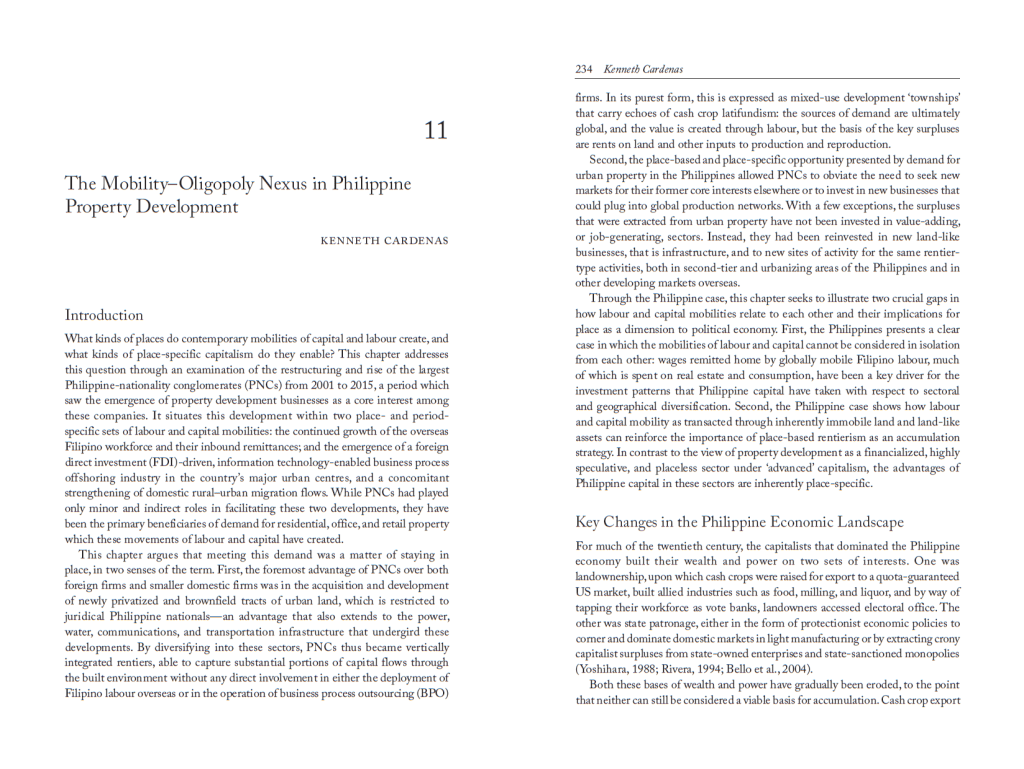
The mobility-oligopoly nexus in Philippine property development

This book chapter appears in Aulakh, P.S. and Kelly, P.F. (2019). Mobilities of Labour and Capital in Asia: Spatialities, Institutions, and Cultures. Cambridge: Cambridge University Press.

What kinds of places do contemporary mobilities of capital and labour create, and what kinds of place-specific capitalisms do they enable? This chapter addresses this question through an examination of the restructuring and rise of the largest Philippine-nationality conglomerates (PNCs) from 2001 to 2015, a period which saw the emergence of property development businesses as a core interest among these companies. It situates this development within two place- and period-specific sets of labour and capital mobilities: the continued growth of the overseas Filipino workforce and their inbound remittances; and the emergence of a foreign direct investment-driven, information technology-enabled business process offshoring industry in the country’s major urban centres, and a concomitant strengthening of domestic rural-urban migration flows. While PNCs had played only minor and indirect roles in facilitating these two developments, they have been the primary beneficiaries of demand for residential, office, and retail property which these movements of labour and capital have created.

Continue reading “The mobility-oligopoly nexus in Philippine property development”