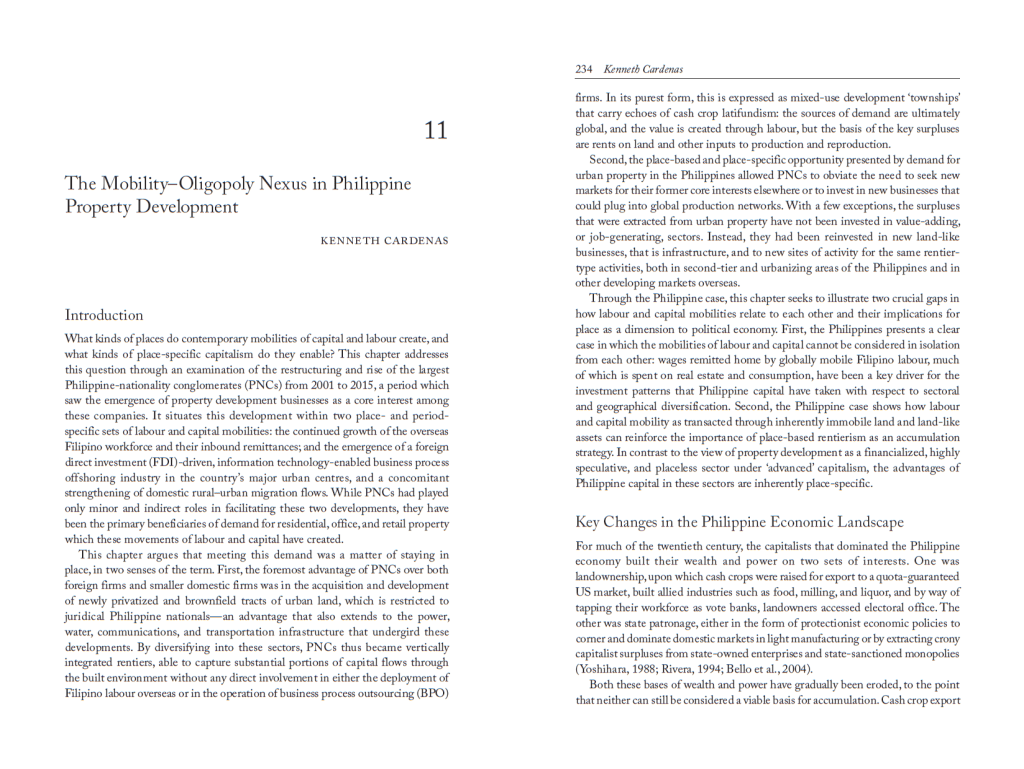
The mobility-oligopoly nexus in Philippine property development

This book chapter appears in Aulakh, P.S. and Kelly, P.F. (2019). Mobilities of Labour and Capital in Asia: Spatialities, Institutions, and Cultures. Cambridge: Cambridge University Press.

What kinds of places do contemporary mobilities of capital and labour create, and what kinds of place-specific capitalisms do they enable? This chapter addresses this question through an examination of the restructuring and rise of the largest Philippine-nationality conglomerates (PNCs) from 2001 to 2015, a period which saw the emergence of property development businesses as a core interest among these companies. It situates this development within two place- and period-specific sets of labour and capital mobilities: the continued growth of the overseas Filipino workforce and their inbound remittances; and the emergence of a foreign direct investment-driven, information technology-enabled business process offshoring industry in the country’s major urban centres, and a concomitant strengthening of domestic rural-urban migration flows. While PNCs had played only minor and indirect roles in facilitating these two developments, they have been the primary beneficiaries of demand for residential, office, and retail property which these movements of labour and capital have created.
Continue reading “The mobility-oligopoly nexus in Philippine property development”
The SEC’s i-Report database

This guide to the Philippine Securities and Exchange Commission’s i-Report database originally ran as a sidebar to my collaboration with Karol Ilagan and Malou Mangahas of the Philippine Center for Investigative Journalism.

AS PART of its mandate to supervise and monitor corporate activity in the Philippines, the Securities and Exchange Commission (SEC) maintains the i-Report database, which contains electronic copies of publicly available corporate filings with the agency. The most readily accessible registry of business entities in the Philippines, the database is indispensable for the everyday work of regulators, lenders, and investors—and was a crucial source of data for this story.

But outside a limited circle of researchers, the database has remained largely underused. This may partly have to do with its relative obscurity, or with the content and format of the documents that may seem inscrutable to lay eyes.

Continue reading “The SEC’s i-Report database”

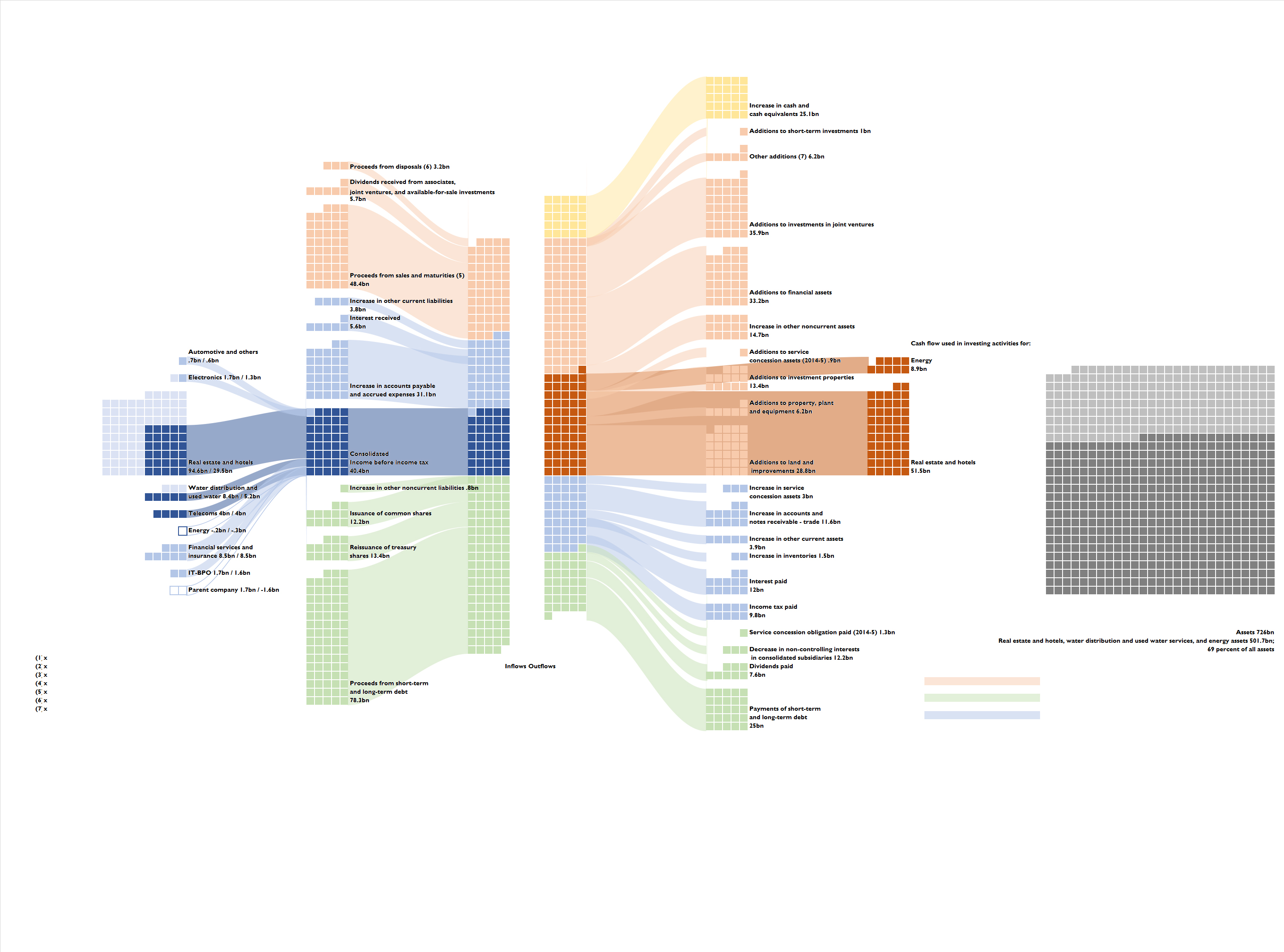
Critical cashflow analysis: Ayala Corporation, 2015

This Sankey diagram depicts data from Ayala Corporation’s 2015 Annual Report: cash flows, both into and out of the company, from and to investing, operating, and financial activities, and total assets. Urban land and infrastructure activities emphasized.

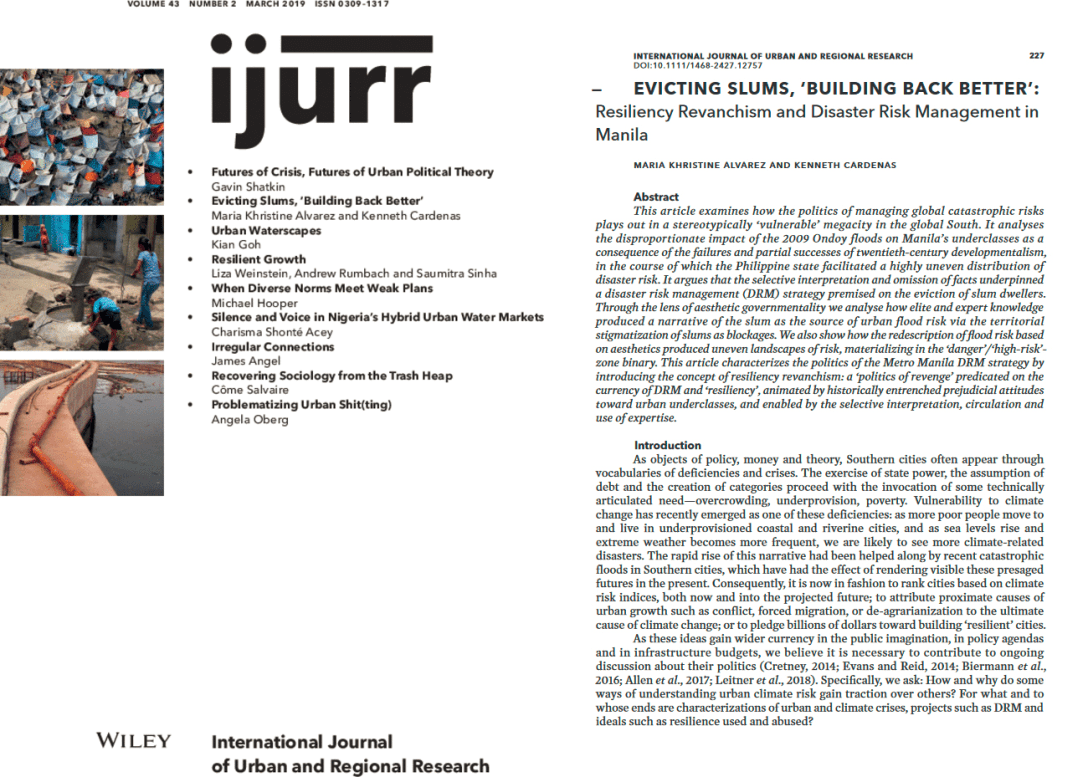
Evicting slums, ‘building back better’

Resiliency revanchism and disaster risk management in Manila

This article examines how the politics of managing global catastrophic risks plays out in a stereotypically ‘vulnerable’ megacity in the global South. It analyses the disproportionate impact of the 2009 Ondoy floods on Manila’s underclasses as a consequence of the failures and partial successes of twentieth-century developmentalism, in the course of which the Philippine state facilitated a highly uneven distribution of disaster risk. It argues that the selective interpretation and omission of facts underpinned a disaster risk management (DRM) strategy premised on the eviction of slum dwellers. Through the lens of aesthetic governmentality we analyse how elite and expert knowledge produced a narrative of the slum as the source of urban flood risk via the territorial stigmatization of slums as blockages. We also show how the redescription of flood risk based on aesthetics produced uneven landscapes of risk, materializing in the ‘danger’/‘high-risk’-zone binary. This article characterizes the politics of the Metro Manila DRM strategy by introducing the concept of resiliency revanchism: a ‘politics of revenge’ predicated on the currency of DRM and ‘resiliency’, animated by historically entrenched prejudicial attitudes toward urban underclasses, and enabled by the selective interpretation, circulation and use of expertise.

This article, co-written with Maria Khristine Alvarez, appeared as part of a symposium on the politics of flooding in Asian megacities, edited by Gavin Shatkin on the International Journal of Urban and Regional Research.

Read the full article here.