Central bank-led capitalism, remittances, and rentier consolidations in the Philippines

This article appears in a special issue of Geoforum on the theme Accounting for Space.

It is the final form of work I had previously presented at the 2025 Annual AAG Meeting in Detroit, and at the Accounting for Space: A critical accounting / critical geography mini-conference in 2023.
Read the full article here.

Highlights

  • From 2001, remittances put the Bangko Sentral ng Pilipinas (BSP) in a central role in reshaping the Philippine economy.
  • The BSP’s able management of monetary policy and banking supervision oversaw a period of exceptional growth and stability.
  • Philippine conglomerates with interests in real estate, infrastructure, and banking consolidated their position.
  • New concentrations of risk have arisen from changes in the debt patterns among these conglomerates.
  • Shadow banking practices by their real estate subsidiaries have also displaced risk onto homebuyers.

Abstract

From 2001, remittances from overseas Filipinos allowed the Bangko Sentral ng Pilipinas (BSP) to amass record US dollar reserves through market operations, and to successfully target inflation while keeping policy rates low. This saw a dramatic shift in the country’s political-economic position, historically marked by balance-of-payments crises and external indebtedness.

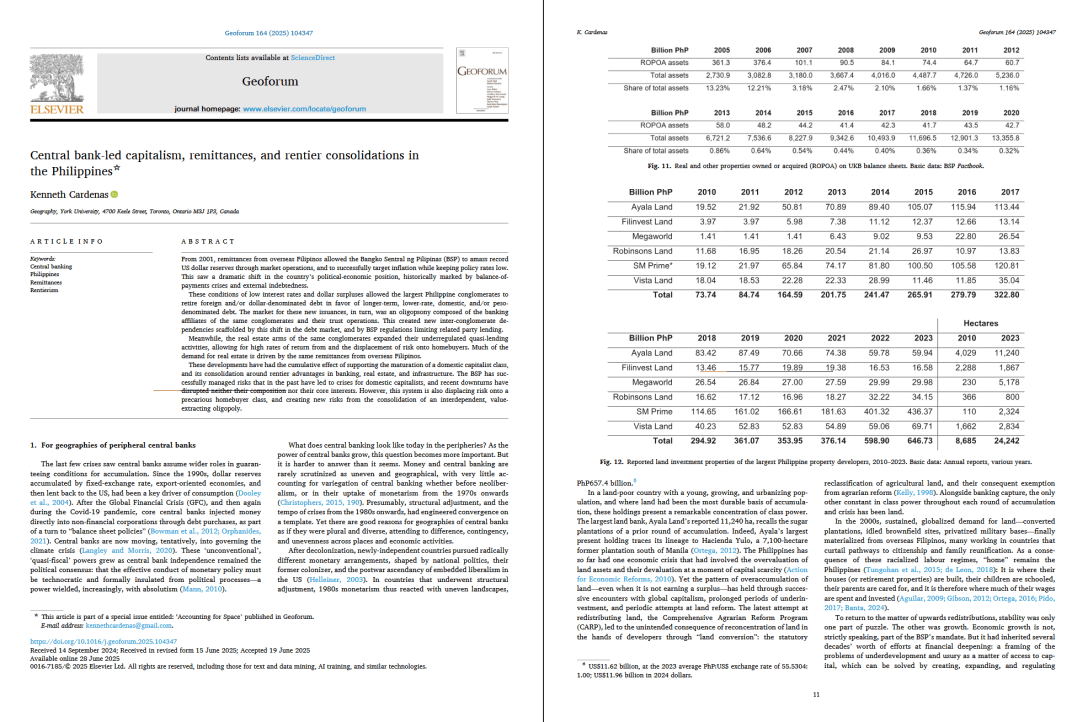
These conditions of low interest rates and dollar surpluses allowed the largest Philippine conglomerates to retire foreign and/or dollar-denominated debt in favor of longer-term, lower-rate, domestic, and/or peso-denominated debt. The market for these new issuances, in turn, was an oligopsony composed of the banking affiliates of the same conglomerates and their trust operations. This created new inter-conglomerate dependencies scaffolded by this shift in the debt market, and by BSP regulations limiting related party lending.

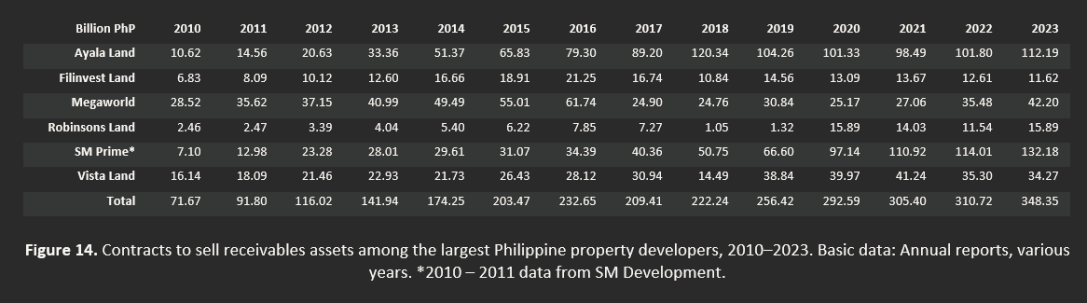
Meanwhile, the real estate arms of the same conglomerates expanded their underregulated quasi-lending activities, allowing for high rates of return from and the displacement of risk onto homebuyers. Much of the demand for real estate is driven by the same remittances from overseas Filipinos.

These developments have had the cumulative effect of supporting the maturation of a domestic capitalist class, and its consolidation around rentier advantages in banking, real estate, and infrastructure. The BSP has successfully managed risks that in the past have led to crises for domestic capitalists, and recent downturns have disrupted neither their composition nor their core interests. However, this system is also displacing risk onto a precarious homebuyer class, and creating new risks from the consolidation of an interdependent, value-extracting oligopoly.

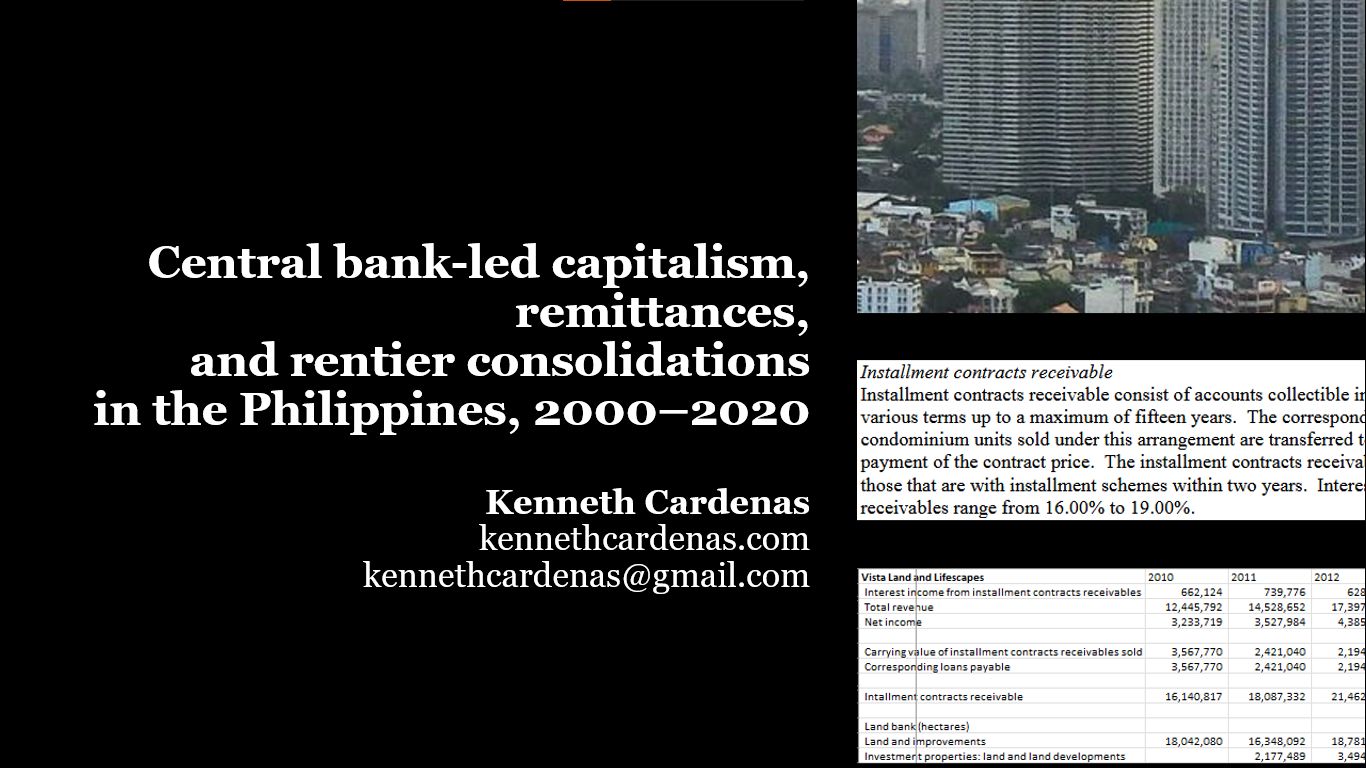
Central bank-led capitalism, remittances, and rentier consolidations in the Philippines

I will be presenting this paper at the 2025 Annual AAG Meeting as part of a session titled Accounting for Space 2: The role of the state in financial infrastructures, and develops work I had first presented at Accounting for Space: A critical accounting / critical geography mini-conference, York University, 20 April 2023.

A final, peer reviewed form of this work is included in a special issue of Geoforum on the theme Accounting for Space.

Read the full article here.

From 2001, remittances from overseas Filipinos allowed the Bangko Sentral ng Pilipinas to amass record US dollar reserves through market operations, and to successfully target inflation while keeping policy rates low. This saw a dramatic shift in the country’s political-economic position, historically marked by balance-of-payments crises and external indebtedness.

These conditions of low interest rates and dollar surpluses allowed the largest Philippine conglomerates to retire foreign and/or dollar-denominated debt in favor of longer-term, lower-rate, domestic, and/or peso-denominated debt. The market for these new issuances, in turn, was an oligopsony composed of the banking affiliates of the same conglomerates and their trust operations. This created new inter-conglomerate dependencies scaffolded by this shift in the debt market, and by BSP regulations limiting related party lending.

Meanwhile, the real estate arms of the same conglomerates expanded their underregulated quasi-lending activities, allowing for high rates of return from and the displacement of risk onto homebuyers. Much of the demand for real estate is driven by the same remittances from overseas Filipinos.

These developments have had the cumulative effect of supporting the maturation of a domestic capitalist class, and its consolidation around rentier advantages in banking, real estate, and infrastructure. The BSP has successfully managed risks that in the past have led to crises for domestic capitalists, and recent downturns have disrupted neither their composition nor their core interests. However, this system is also displacing risk onto a precarious homebuyer class, and creating new risks from the consolidation of an interdependent, value-extracting oligopoly.

Energy after the new strongmen:

Notes for the next revolution

I will be presenting this paper at Dynamics of Change and Continuity in Philippine Political Economy: Martial Law and the Marcos Restoration on 24 February 2023.

Energy industry reform was one of the defining features of the Edsa Republic’s political economy. It involved the largest privatizations, the largest flows of fresh investment, and the most profitable arms of the largest Philippine conglomerates. As a marquee policy, it also offered a way for successive post-Marcos administrations to signal their commitment to their creditors, repudiate the state-directed orthodoxy of 20th century development thinking, and experiment with a doctrinaire form of neoliberalism.

Yet market rule broke many of its promises. Monopolization, high prices, and supply shortfalls remain, or have deepened. In abandoning grand, strategic public investment, and in prioritizing investor sentiment and creditworthiness over the quality and price of a modernizing good, energy industry reform saw neoliberalism at the household level, and likely contributed to nostalgia for the megaproject-focused approach last seen under the Bagong Lipunan.

This paper articulates a refusal against both the neoliberalization of energy under the Edsa Republic, and the surrender to “political will”, with its attendant risk of crony capitalism and authoritarianism, pushed by the Philippines’ new strongmen. I argue that electrification uniquely offers embedded lessons for disentangling public investment and commons formation from authoritarianism, debt traps, and development aggression. By listening to the expertise that had been cultivated within Napocor in the late 20th century, and in electric cooperatives in the early 21st, and by anticipating energy transitions and crises in the medium-term future, I aim to recuperate a latent developmentalism within the Philippine energy industry as a reservoir of possibility for the next revolution. I pay specific attention to efficiencies that cannot be discovered and/or distorted by the market, and to forms of resistance to centralized power that inhere within the Philippine energy landscape.

Measuring the Manila square meter

This essay originally appeared in the catalogue for the exhibition titledLiving Spaces: Hyperreal Estate and the Architecture of Dispossession“, curated by Alice Sarmiento. I wrote it in conversation with, and with thanks to, Alice Sarmiento, Andre Ortega, and Maria Khristine Alvarez.

Consider the average Manila billboard.

It is many times larger than the average Manila home. Perched above Manila’s hypertensive roads, it gets better breeze, sunlight, and sight lines than the average Manila home; its floodlights consume more power than several average Manila homes.

The visuals of the average Manila billboard are also larger than the average Manila life—especially when they peddle condominiums, those new average Manila homes for the 21st century. They feature models with impossibly white, impossibly smooth skins, living impossibly carefree lives of minutes-away convenience from the best that the city can offer, all under impossibly blue skies.

From a messaging point of view, the average Manila billboard needs to be larger than life. It must, after all, be heard above the jostle of shoulders, the knots in our backs, and the blare of last night’s death toll—all before we heave and lurch our way onto the next billboard.

It then needs to tell, within the limits set by 216 square meters,[1] convincing lies: small lies, about the life of grandeur possible within an eighteen square-meter unit,[2] about how the baked air takes your breath away, or about the mysterious dues and fees that await.

Fig. 1. About twelve 18m2 Manila studio units can fit within a 216m2 Manila billboard.

Continue reading “Measuring the Manila square meter”