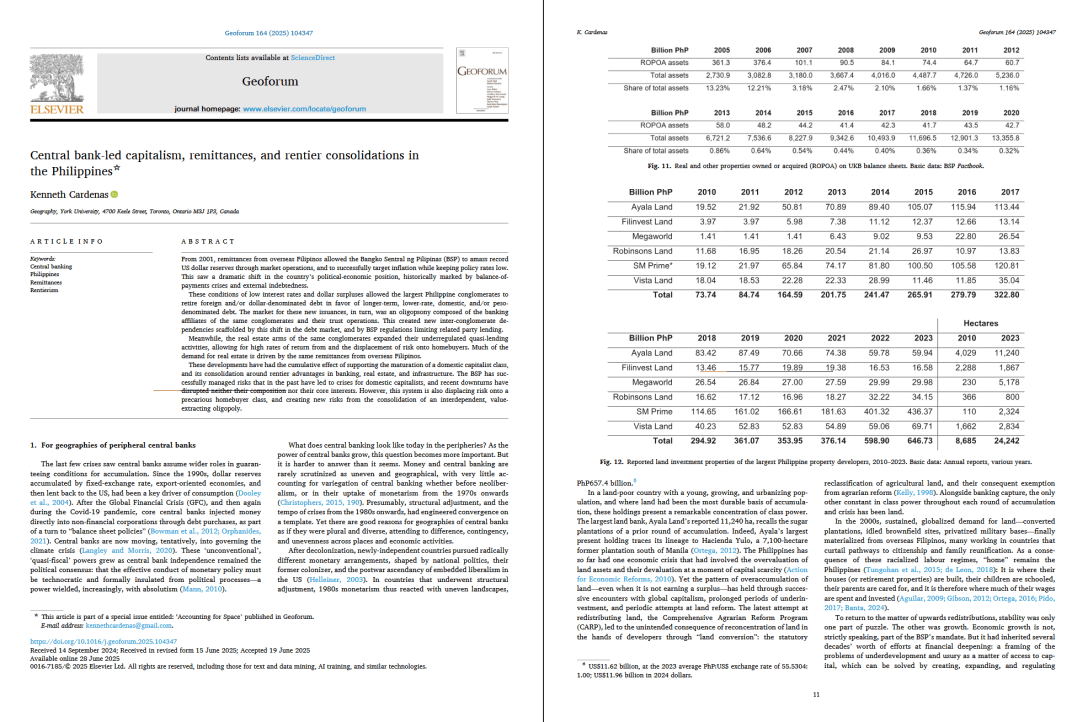
Central bank-led capitalism, remittances, and rentier consolidations in the Philippines

This article appears in a special issue of Geoforum on the theme Accounting for Space.

It is the final form of work I had previously presented at the 2025 Annual AAG Meeting in Detroit, and at the Accounting for Space: A critical accounting / critical geography mini-conference in 2023.
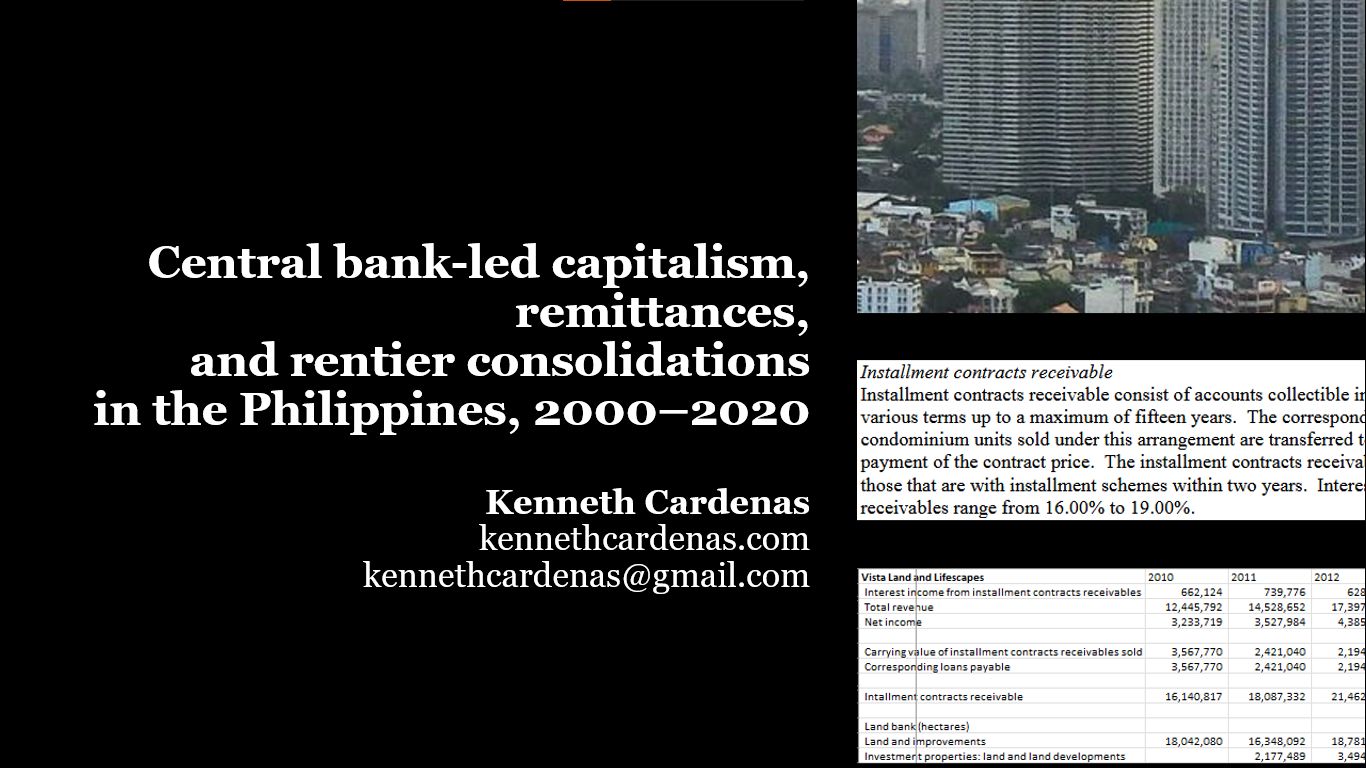
Read the full article here.

Highlights

  • From 2001, remittances put the Bangko Sentral ng Pilipinas (BSP) in a central role in reshaping the Philippine economy.
  • The BSP’s able management of monetary policy and banking supervision oversaw a period of exceptional growth and stability.
  • Philippine conglomerates with interests in real estate, infrastructure, and banking consolidated their position.
  • New concentrations of risk have arisen from changes in the debt patterns among these conglomerates.
  • Shadow banking practices by their real estate subsidiaries have also displaced risk onto homebuyers.

Abstract

From 2001, remittances from overseas Filipinos allowed the Bangko Sentral ng Pilipinas (BSP) to amass record US dollar reserves through market operations, and to successfully target inflation while keeping policy rates low. This saw a dramatic shift in the country’s political-economic position, historically marked by balance-of-payments crises and external indebtedness.

These conditions of low interest rates and dollar surpluses allowed the largest Philippine conglomerates to retire foreign and/or dollar-denominated debt in favor of longer-term, lower-rate, domestic, and/or peso-denominated debt. The market for these new issuances, in turn, was an oligopsony composed of the banking affiliates of the same conglomerates and their trust operations. This created new inter-conglomerate dependencies scaffolded by this shift in the debt market, and by BSP regulations limiting related party lending.

Meanwhile, the real estate arms of the same conglomerates expanded their underregulated quasi-lending activities, allowing for high rates of return from and the displacement of risk onto homebuyers. Much of the demand for real estate is driven by the same remittances from overseas Filipinos.

These developments have had the cumulative effect of supporting the maturation of a domestic capitalist class, and its consolidation around rentier advantages in banking, real estate, and infrastructure. The BSP has successfully managed risks that in the past have led to crises for domestic capitalists, and recent downturns have disrupted neither their composition nor their core interests. However, this system is also displacing risk onto a precarious homebuyer class, and creating new risks from the consolidation of an interdependent, value-extracting oligopoly.

Central bank-led capitalism, remittances, and rentier consolidations in the Philippines

I will be presenting this paper at the 2025 Annual AAG Meeting as part of a session titled Accounting for Space 2: The role of the state in financial infrastructures, and develops work I had first presented at Accounting for Space: A critical accounting / critical geography mini-conference, York University, 20 April 2023.

A final, peer reviewed form of this work is included in a special issue of Geoforum on the theme Accounting for Space.

Read the full article here.

From 2001, remittances from overseas Filipinos allowed the Bangko Sentral ng Pilipinas to amass record US dollar reserves through market operations, and to successfully target inflation while keeping policy rates low. This saw a dramatic shift in the country’s political-economic position, historically marked by balance-of-payments crises and external indebtedness.

These conditions of low interest rates and dollar surpluses allowed the largest Philippine conglomerates to retire foreign and/or dollar-denominated debt in favor of longer-term, lower-rate, domestic, and/or peso-denominated debt. The market for these new issuances, in turn, was an oligopsony composed of the banking affiliates of the same conglomerates and their trust operations. This created new inter-conglomerate dependencies scaffolded by this shift in the debt market, and by BSP regulations limiting related party lending.

Meanwhile, the real estate arms of the same conglomerates expanded their underregulated quasi-lending activities, allowing for high rates of return from and the displacement of risk onto homebuyers. Much of the demand for real estate is driven by the same remittances from overseas Filipinos.

These developments have had the cumulative effect of supporting the maturation of a domestic capitalist class, and its consolidation around rentier advantages in banking, real estate, and infrastructure. The BSP has successfully managed risks that in the past have led to crises for domestic capitalists, and recent downturns have disrupted neither their composition nor their core interests. However, this system is also displacing risk onto a precarious homebuyer class, and creating new risks from the consolidation of an interdependent, value-extracting oligopoly.

“De-Marcosification” and the rise of new urban rentiers:

On the unintended consequences of post-EDSA privatizations.

I will be presenting this paper at the The 5th Philippine Studies Conference in Japan organized by the Annual Philippine Studies Forum in Japan, on 27 November 2022. A version of this work was published on Philippine Studies: Historical and Ethnographic Viewpoints as The EDSA Republic as moral liquidator: Embedded origins, unintended consequences.

This paper revisits the lasting imprint left by privatizations after the EDSA Revolution on the development of capitalism in the Philippines in the early 21st century, with an emphasis on path-dependence, unintended consequences, and domestic technocratic and bureaucratic actors.

Focusing on the efforts of the Presidential Commission on Government Reorganization (PCGR) in the late 1980s, it re-evaluates how a specific understanding of the state’s role in the economy was developed through the reorganization of crony- and state-owned enterprises. It proposes that consequential features of privatization were not the outcome of an ideologically-coherent liberalization. Instead, they were part of a moralized “De-Marcosification” process: liquidating crony-owned or inefficient state investments to fund agrarian reform. This practice of linking proceeds from privatizations to specific policy objectives, in the form of “special accounts”, had since proliferated across the Philippine government. Key development and policy objectives were linked to the speed and constancy of asset liquidation, and became decisive in how privatizations in the 1990s and 2000s were implemented.

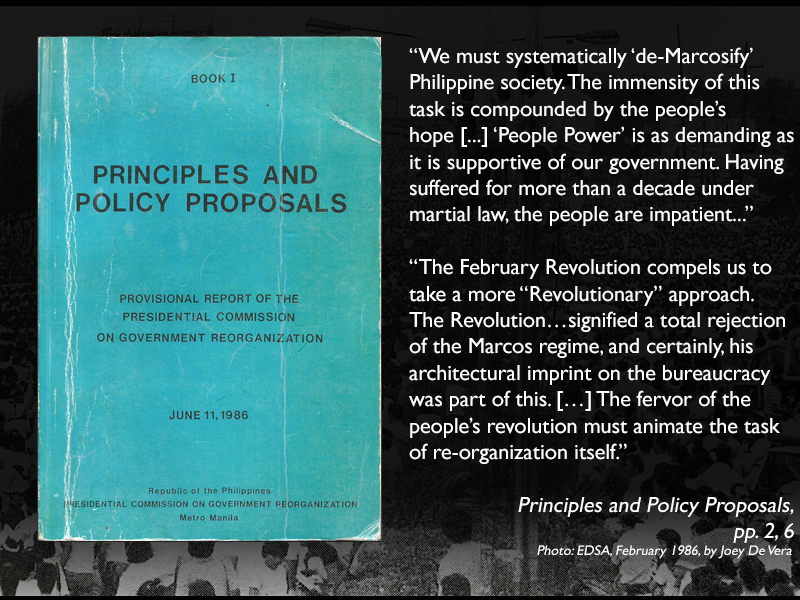
“We must systematically ‘de-Marcosify’ society.” From Principles and Policy Proposals, the provisional report of the Presidential Commission on Government Reorganization.
Continue reading ““De-Marcosification” and the rise of new urban rentiers:”

The mobility-oligopoly nexus in Philippine property development

This book chapter appears in Aulakh, P.S. and Kelly, P.F. (2019). Mobilities of Labour and Capital in Asia: Spatialities, Institutions, and Cultures. Cambridge: Cambridge University Press.

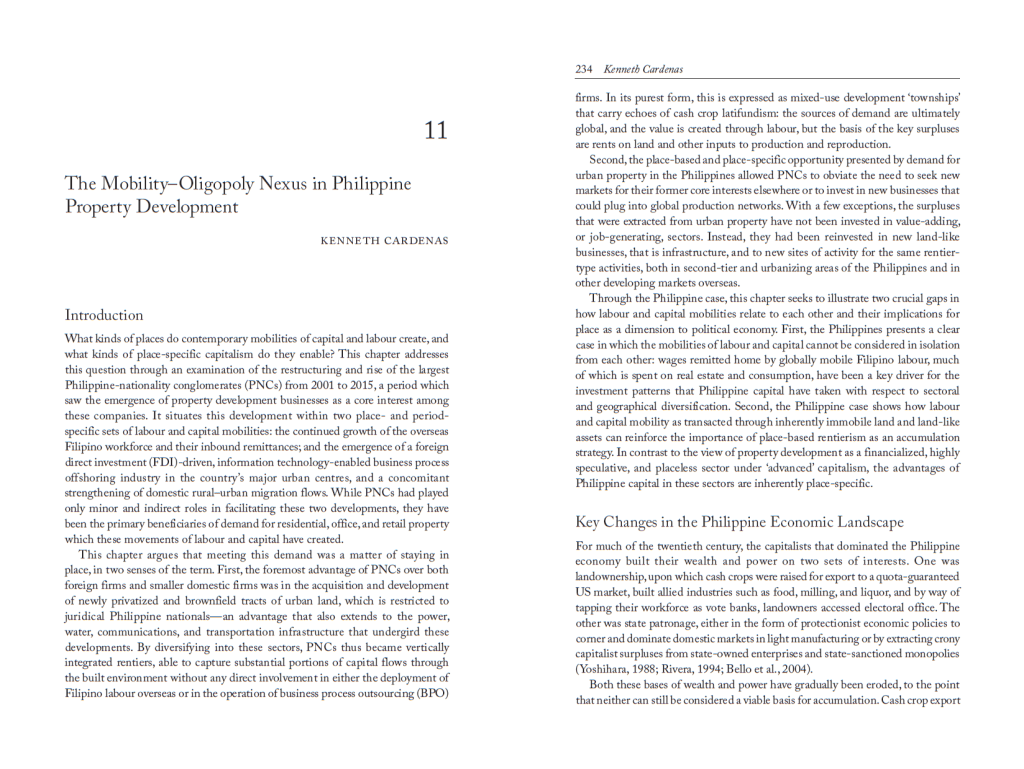
What kinds of places do contemporary mobilities of capital and labour create, and what kinds of place-specific capitalisms do they enable? This chapter addresses this question through an examination of the restructuring and rise of the largest Philippine-nationality conglomerates (PNCs) from 2001 to 2015, a period which saw the emergence of property development businesses as a core interest among these companies. It situates this development within two place- and period-specific sets of labour and capital mobilities: the continued growth of the overseas Filipino workforce and their inbound remittances; and the emergence of a foreign direct investment-driven, information technology-enabled business process offshoring industry in the country’s major urban centres, and a concomitant strengthening of domestic rural-urban migration flows. While PNCs had played only minor and indirect roles in facilitating these two developments, they have been the primary beneficiaries of demand for residential, office, and retail property which these movements of labour and capital have created.

Continue reading “The mobility-oligopoly nexus in Philippine property development”