“De-Marcosification” and the rise of new urban rentiers

On the unintended consequences of post-EDSA privatizations

I will be presenting this paper at the The 5th Philippine Studies Conference in Japan organized by the Annual Philippine Studies Forum in Japan, on 27 November 2022. A version of this work was published on Philippine Studies: Historical and Ethnographic Viewpoints as The EDSA Republic as moral liquidator: Embedded origins, unintended consequences.

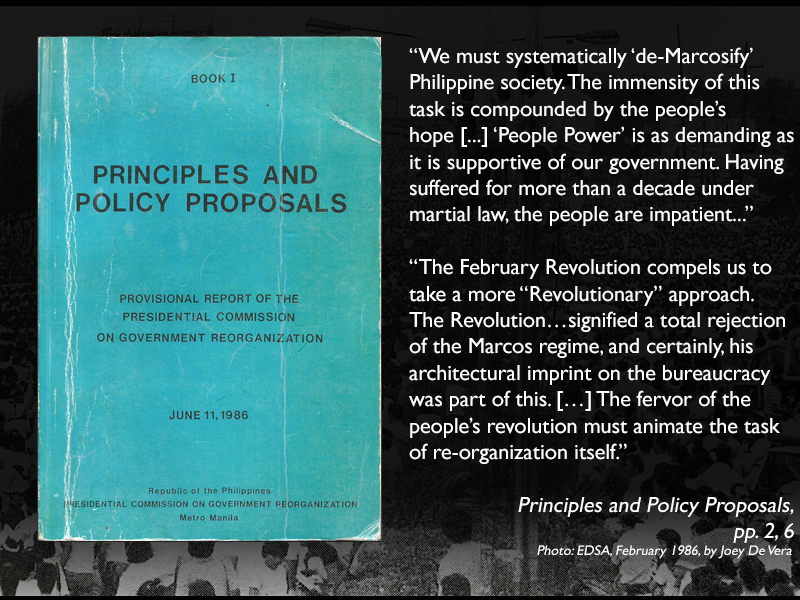
This paper revisits the lasting imprint left by privatizations after the EDSA Revolution on the development of capitalism in the Philippines in the early 21st century, with an emphasis on path-dependence, unintended consequences, and domestic technocratic and bureaucratic actors.

Focusing on the efforts of the Presidential Commission on Government Reorganization (PCGR) in the late 1980s, it re-evaluates how a specific understanding of the state’s role in the economy was developed through the reorganization of crony- and state-owned enterprises. It proposes that consequential features of privatization were not the outcome of an ideologically-coherent liberalization. Instead, they were part of a moralized “De-Marcosification” process: liquidating crony-owned or inefficient state investments to fund agrarian reform. This practice of linking proceeds from privatizations to specific policy objectives, in the form of “special accounts”, had since proliferated across the Philippine government. Key development and policy objectives were linked to the speed and constancy of asset liquidation, and became decisive in how privatizations in the 1990s and 2000s were implemented.

Continue reading ““De-Marcosification” and the rise of new urban rentiers”

Measuring the Manila square meter

This essay originally appeared in the catalogue for the exhibition titledLiving Spaces: Hyperreal Estate and the Architecture of Dispossession“, curated by Alice Sarmiento. I wrote it in conversation with, and with thanks to, Alice Sarmiento, Andre Ortega, and Maria Khristine Alvarez.

Consider the average Manila billboard.

It is many times larger than the average Manila home. Perched above Manila’s hypertensive roads, it gets better breeze, sunlight, and sight lines than the average Manila home; its floodlights consume more power than several average Manila homes.

The visuals of the average Manila billboard are also larger than the average Manila life—especially when they peddle condominiums, those new average Manila homes for the 21st century. They feature models with impossibly white, impossibly smooth skins, living impossibly carefree lives of minutes-away convenience from the best that the city can offer, all under impossibly blue skies.

From a messaging point of view, the average Manila billboard needs to be larger than life. It must, after all, be heard above the jostle of shoulders, the knots in our backs, and the blare of last night’s death toll—all before we heave and lurch our way onto the next billboard.

It then needs to tell, within the limits set by 216 square meters,[1] convincing lies: small lies, about the life of grandeur possible within an eighteen square-meter unit,[2] about how the baked air takes your breath away, or about the mysterious dues and fees that await.

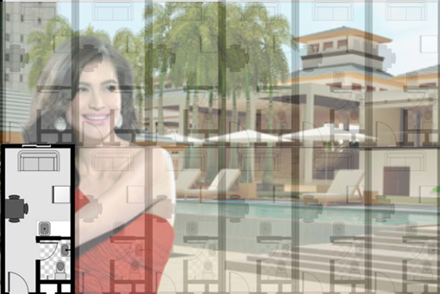
Fig. 1. About twelve 18m2 Manila studio units can fit within a 216m2 Manila billboard.

Continue reading “Measuring the Manila square meter”

Kung Saan Man Tayo / Wherever We May Be

Kung Saan Man Tayo will be screened virtually by the Center for Southeast Asian Studies of University of Hawaiʻi at Mānoa from 4 to 9 February 2022.

In 2014, filmmaker Adrian Alarilla sent a camera on an eastbound circumnavigation of the world. The camera, named Enrique after Panglima Awang/Enrique of Malacca, was to tell the stories of seven overseas Filipinxs, as part of an ongoing corrective to the stories of conquest, plunder, and exploitation that begun five hundred years ago.

For a few weeks in the summer of 2014, while I was reading for my comprehensive exams, I hosted Enrique in Toronto, on the first stop of a journey that involved Paris, Tübingen, Bangkok, Singapore, and Melbourne.

Adrian wove these stories into Kung Saan Man Tayo, an 80-minute documentary released in 2021.

Continue reading “Kung Saan Man Tayo / Wherever We May Be”