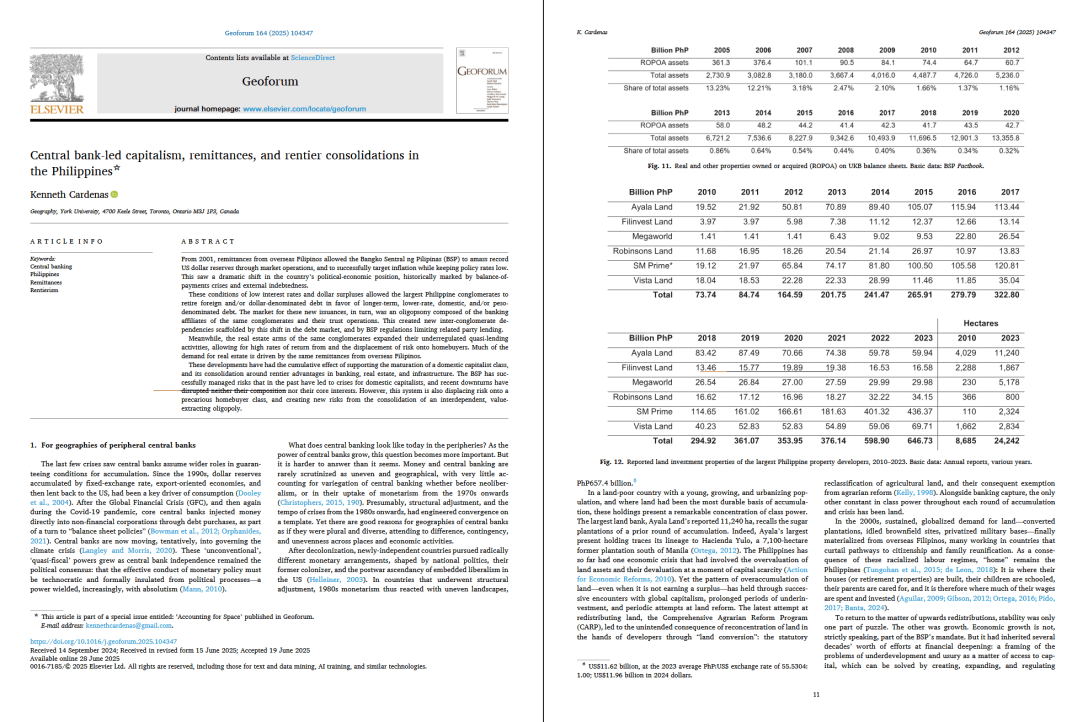
Central bank-led capitalism, remittances, and rentier consolidations in the Philippines

This article appears in a special issue of Geoforum on the theme Accounting for Space.

It is the final form of work I had previously presented at the 2025 Annual AAG Meeting in Detroit, and at the Accounting for Space: A critical accounting / critical geography mini-conference in 2023.
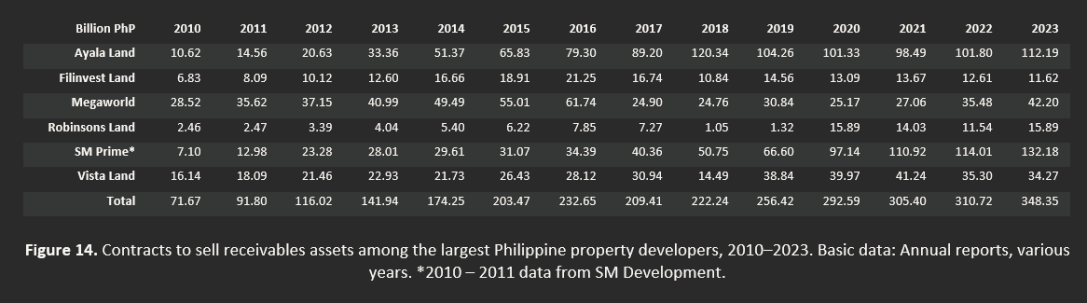
Read the full article here.

Highlights

  • From 2001, remittances put the Bangko Sentral ng Pilipinas (BSP) in a central role in reshaping the Philippine economy.
  • The BSP’s able management of monetary policy and banking supervision oversaw a period of exceptional growth and stability.
  • Philippine conglomerates with interests in real estate, infrastructure, and banking consolidated their position.
  • New concentrations of risk have arisen from changes in the debt patterns among these conglomerates.
  • Shadow banking practices by their real estate subsidiaries have also displaced risk onto homebuyers.

Abstract

From 2001, remittances from overseas Filipinos allowed the Bangko Sentral ng Pilipinas (BSP) to amass record US dollar reserves through market operations, and to successfully target inflation while keeping policy rates low. This saw a dramatic shift in the country’s political-economic position, historically marked by balance-of-payments crises and external indebtedness.

These conditions of low interest rates and dollar surpluses allowed the largest Philippine conglomerates to retire foreign and/or dollar-denominated debt in favor of longer-term, lower-rate, domestic, and/or peso-denominated debt. The market for these new issuances, in turn, was an oligopsony composed of the banking affiliates of the same conglomerates and their trust operations. This created new inter-conglomerate dependencies scaffolded by this shift in the debt market, and by BSP regulations limiting related party lending.

Meanwhile, the real estate arms of the same conglomerates expanded their underregulated quasi-lending activities, allowing for high rates of return from and the displacement of risk onto homebuyers. Much of the demand for real estate is driven by the same remittances from overseas Filipinos.

These developments have had the cumulative effect of supporting the maturation of a domestic capitalist class, and its consolidation around rentier advantages in banking, real estate, and infrastructure. The BSP has successfully managed risks that in the past have led to crises for domestic capitalists, and recent downturns have disrupted neither their composition nor their core interests. However, this system is also displacing risk onto a precarious homebuyer class, and creating new risks from the consolidation of an interdependent, value-extracting oligopoly.

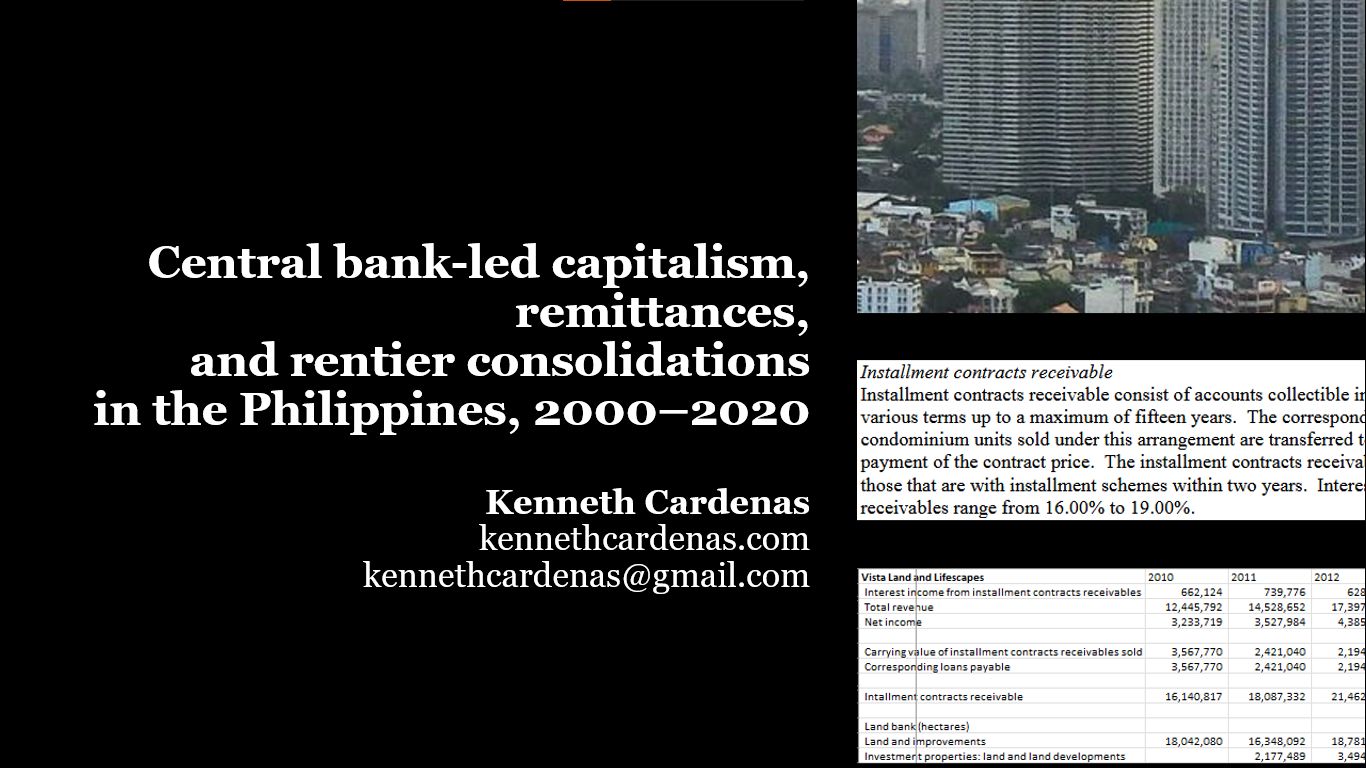
Central bank-led capitalism, remittances, and rentier consolidations in the Philippines

I will be presenting this paper at the 2025 Annual AAG Meeting as part of a session titled Accounting for Space 2: The role of the state in financial infrastructures, and develops work I had first presented at Accounting for Space: A critical accounting / critical geography mini-conference, York University, 20 April 2023.

A final, peer reviewed form of this work is included in a special issue of Geoforum on the theme Accounting for Space.

Read the full article here.

From 2001, remittances from overseas Filipinos allowed the Bangko Sentral ng Pilipinas to amass record US dollar reserves through market operations, and to successfully target inflation while keeping policy rates low. This saw a dramatic shift in the country’s political-economic position, historically marked by balance-of-payments crises and external indebtedness.

These conditions of low interest rates and dollar surpluses allowed the largest Philippine conglomerates to retire foreign and/or dollar-denominated debt in favor of longer-term, lower-rate, domestic, and/or peso-denominated debt. The market for these new issuances, in turn, was an oligopsony composed of the banking affiliates of the same conglomerates and their trust operations. This created new inter-conglomerate dependencies scaffolded by this shift in the debt market, and by BSP regulations limiting related party lending.

Meanwhile, the real estate arms of the same conglomerates expanded their underregulated quasi-lending activities, allowing for high rates of return from and the displacement of risk onto homebuyers. Much of the demand for real estate is driven by the same remittances from overseas Filipinos.

These developments have had the cumulative effect of supporting the maturation of a domestic capitalist class, and its consolidation around rentier advantages in banking, real estate, and infrastructure. The BSP has successfully managed risks that in the past have led to crises for domestic capitalists, and recent downturns have disrupted neither their composition nor their core interests. However, this system is also displacing risk onto a precarious homebuyer class, and creating new risks from the consolidation of an interdependent, value-extracting oligopoly.

Back to the land

This material originally appeared as  a chapter in W. Bello and J. Chavez (eds.) State of Fragmentation: The Philippines in Transition. Bangkok: Focus on the Global South.

This entry is the third of a four-part serialization.

Part I
Part II: The new rules of the game

Part IV: The city and the restoration of class power

All these transformations—the Philippine brand of neoliberalization, the unique vectors through which its economy globalized, and its uneven sectoral and geographical development—converge in urban real estate. Mirroring the trajectory of the economy as a whole, real estate development began the decade in crisis: the sector shrank from 2000 to 2002, hitting a 24.7 percent year-on-year contraction in the first quarter of 2001. But beginning with 2003, residential lot sales, coupled with office and retail space rental and leasing, have sustained record levels of growth: from the second quarter of 2004 until the fourth quarter of 2008, it sustained a double-digit streak, broken only twice by dips into high single-digit growth rates (see Figure 3). In the third quarter of 2006, the sector grew at a record pace of 26.2 percent year-on-year, breaking a record that was previously set in the third quarter of 1982. This record was broken yet again when the sector grew by 27.7 percent in the second quarter of 2010. At the end of its bust period in 2002, the gross value added of real estate development stood at approximately PhP8.8 billion. In 2010, it had grown to PhP22.1 billion.[1] If considered as a separate subsector, real estate was the second-fastest growing sector of the economy over the past decade, outpaced only by mining.

Continue reading “Back to the land”