Empire as insular, unsophisticated, incoherent

Commentary on Scott Kirsch’s American Colonial Spaces in the Philippines: Insular Empire

At the 2025 AAG Meeting in Detroit, I was part of an author meets readers panel for Scott Kirsch’s American Colonial Spaces in the Philippines: Insular Empire.

The panel was organized by Christian C. Lentz, Michael Hawkins, and Joseph Palis, and included commentary from Kristian Saguin, Mona Domosh, Don Mitchell, and myself.

A version of our comments was published in September 2025 for the Singapore Journal of Tropical Geography. What follows is my original unabridged commentary.


Let me begin by making a distinction between the violence and injustice of American imperialism on one hand, and its sophistication, coherence, and success on the other. Though at perpetual risk of erasure, the evidence for the former in the Philippines is plentiful. But this is not necessarily evidence of a total, nor monolithic, nor coherent project.

To resist the erasure of American imperialism, and to understand its ongoing legacies, it is important not to ascribe to it more power than it could actually muster. We could instead name its weaknesses and contradictions, through finer-grained close studies, and show just how vain, incomplete, and unsuccessful its schemes are. And what better way to do this than to study Great Men and their Grand Designs, at the height of their hubris?

Continue reading “Empire as insular, unsophisticated, incoherent”
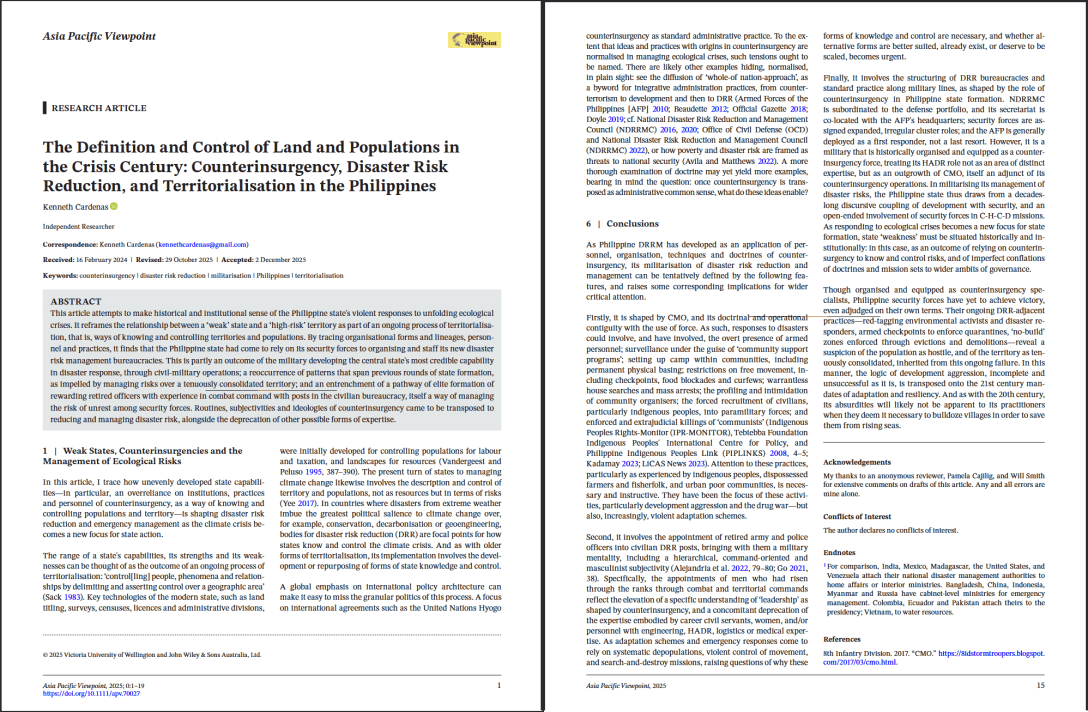
The definition and control of land and populations in the crisis century

Counterinsurgency, disaster risk reduction, and territorialisation in the Philippines

This article attempts to make historical and institutional sense of the Philippine state’s violent responses to unfolding ecological crises. It reframes the relationship between a ‘weak’ state and a ‘high-risk’ territory as part of an ongoing process of territorialisation, that is, ways of knowing and controlling territories and populations. By tracing organisational forms and lineages, personnel and practices, it finds that the Philippine state had come to rely on its security forces to organising and staff its new disaster risk management bureaucracies. This is partly an outcome of the military developing the central state’s most credible capability in disaster response, through civil-military operations; a reoccurrence of patterns that span previous rounds of state formation, as impelled by managing risks over a tenuously consolidated territory; and an entrenchment of a pathway of elite formation of rewarding retired officers with experience in combat command with posts in the civilian bureaucracy, itself a way of managing the risk of unrest among security forces. Routines, subjectivities and ideologies of counterinsurgency came to be transposed to reducing and managing disaster risk, alongside the deprecation of other possible forms of expertise.

This article appears in a special issue of Asia Pacific Viewpoint on the theme More-than-complex: Governance and place in Philippine disaster management.

It is the final form of work I had previously presented at the Governing Complex Disasters in Southeast Asia workshop in 2023.

Read the full article here.