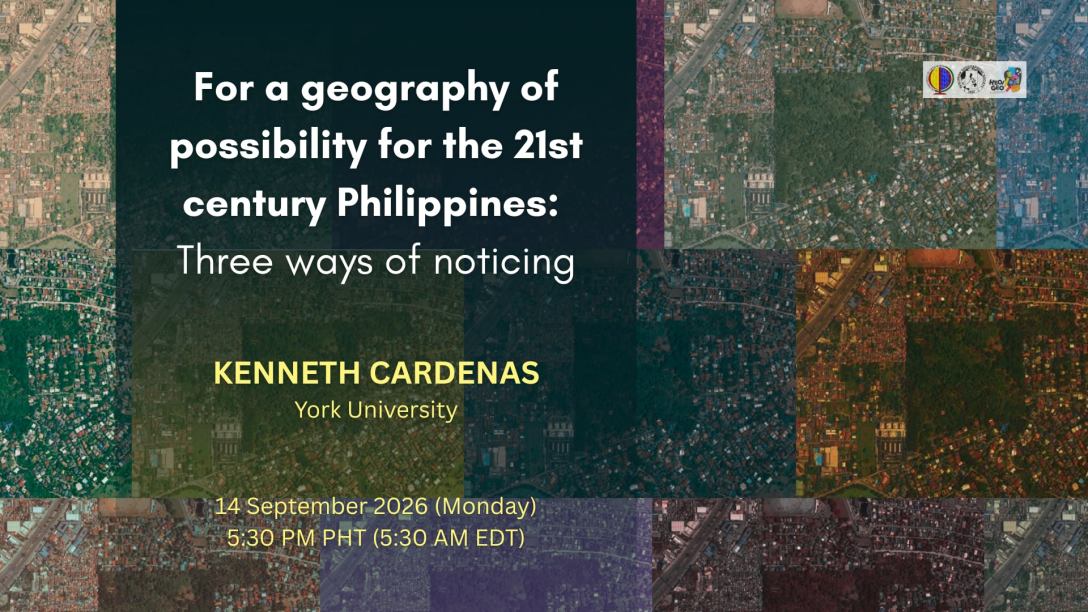
For a geography of possibility for the 21st century Philippines

Three ways of noticing

The UP Department of Geography and the Philippine Geographical Society (PGS) proudly present this month’s Heo/Geo Lecture with Dr Kenneth Cardenas as speaker. This will be on Monday, 14 September 2026 at 5:30PM (Philippine Time) / 5:30AM (Eastern Standard Time) via Zoom.

In this talk I suggest three ways of seeing possibility in the political economy of the early 21st century Philippines. I articulate a version of geography as it attuned to unevenness and difference, uniquely positioned as a mode of knowledge for reading against ‘damage-centred’ accounts of neoliberalism, underdevelopment, and inequality. Specifically, reflexive, careful attention to scale and abstraction, as dimensions to how we theorize about the Philippines, can help sensitize us to how projects of concentrating wealth and power had never fully consolidated in this place, and to the ways that non-, anti-, and post-capitalist practices co-constitute its economic and political life. 

Through completed and in-progress research on capitalism and state formation in the Philippines, I illustrate (1.) attention to long timescales, (2.) small spatial and institutional scales, and (3.) unlikely comparisons across places, periods, and commodity relations as elements to a research repertoire in the aid of noticing possibility.
To participate in the lecture, use this link to register. 

Water and time, Summer 2026

Walk, Talk & Connect,
with the Cooksville SNAP of the
Credit Valley Conservation Authority

Saturday, 22 August 2026 | 9:00 a.m. | John C. Price Playground. Register here

Join CVC’s Cooksville SNAP team alongside Kenneth and Moneira, local Cooksville residents and avid nature lovers, for a family-friendly walk along Cooksville Creek. Let’s have conversations about what brings us (humans, nonhumans, ancestors and future kin), together. Let’s talk about about portals to an alternate, actually-existing Mississauga, about inhabiting a place, and about nature.

This is a shorter, all-ages friendly, late-summer version of a Jane’s Walk that we have been conducting for two years, and hope to run for as long as we are your neighbours.

This event is part of the Cooksville Sustainable Actions Neighbourhood Plan (SNAP) and everyone is welcome to join, whether you live, work or play in Cooksville (or beyond)!

Meet us at the Little John Lane entrance to John C. Price Park. We encourage you to walk, roll, or take transit to the event. Parking is available along Kirwin Avenue. Please pay attention to road signs.

Water and time, Spring 2026

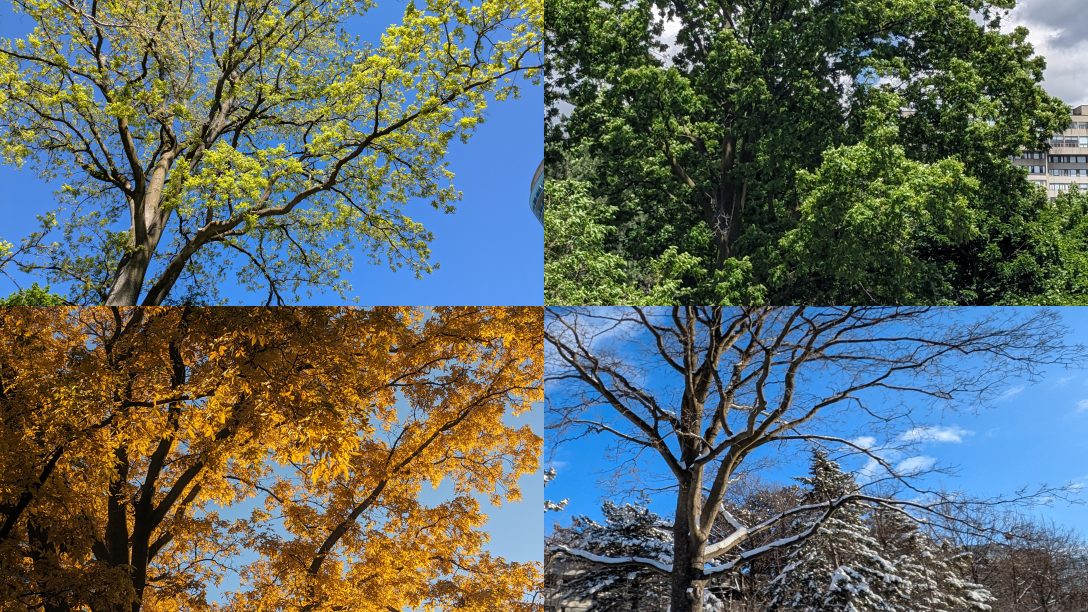
Cooksville Creek, from microseasons to this millennium

Sunday, 3 May 2026 | 2:00 p.m. | John C. Price Playground to the oldest(??) tree in Mississauga City Centre. Part of the Jane’s Walk Festival 2026.

Let’s take a walk along Mississauga’s Cooksville Creek, as an exercise in traveling deep, and not far across both time and space. Let’s have conversations about what brings us—people, peoples, and place; humans and nonhumans; ancestors and future kin—together; about portals to an alternate, actually-existing Mississauga; about inhabiting a place; and about water.

Continue reading “Water and time, Spring 2026”

Empire as insular, unsophisticated, incoherent

Commentary on Scott Kirsch’s American Colonial Spaces in the Philippines: Insular Empire

At the 2025 AAG Meeting in Detroit, I was part of an author meets readers panel for Scott Kirsch’s American Colonial Spaces in the Philippines: Insular Empire.

The panel was organized by Christian C. Lentz, Michael Hawkins, and Joseph Palis, and included commentary from Kristian Saguin, Mona Domosh, Don Mitchell, and myself.

A version of our comments was published in September 2025 for the Singapore Journal of Tropical Geography. What follows is my original unabridged commentary.


Let me begin by making a distinction between the violence and injustice of American imperialism on one hand, and its sophistication, coherence, and success on the other. Though at perpetual risk of erasure, the evidence for the former in the Philippines is plentiful. But this is not necessarily evidence of a total, nor monolithic, nor coherent project.

To resist the erasure of American imperialism, and to understand its ongoing legacies, it is important not to ascribe to it more power than it could actually muster. We could instead name its weaknesses and contradictions, through finer-grained close studies, and show just how vain, incomplete, and unsuccessful its schemes are. And what better way to do this than to study Great Men and their Grand Designs, at the height of their hubris?

Continue reading “Empire as insular, unsophisticated, incoherent”