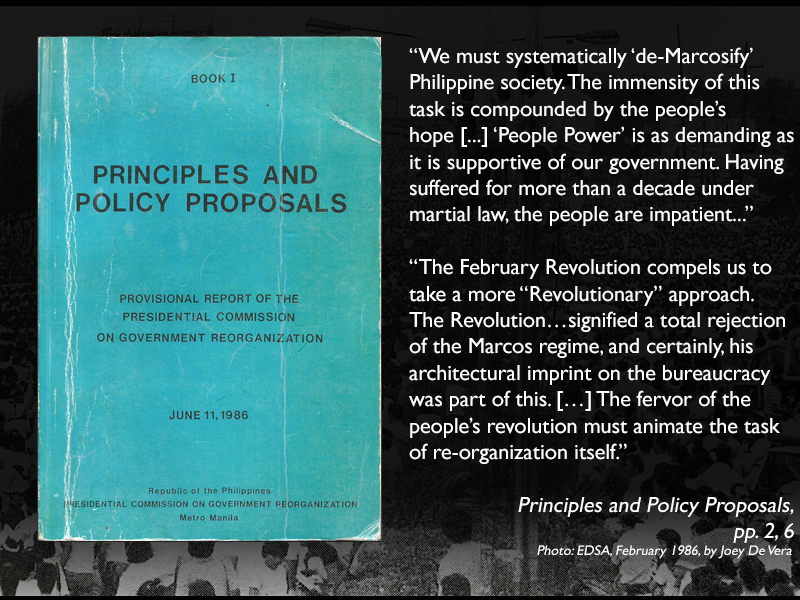
“We must systematically ‘de-Marcosify’ Philippine society”

On the embedded precursors and unintended consequences of Edsa Republic privatizations

I presented this paper at the 2024 Association for Asian Studies annual conference in Seattle, and builds on my 2022 presentation at the Philippine Studies Conference in Japan. A version of it was published on Philippine Studies: Historical and Ethnographic Viewpoints as The EDSA Republic as moral liquidator: Embedded origins, unintended consequences.

Access the full article through Project Muse here.

This article revisits the privatizations carried out after the Edsa Revolution, emphasizing historical context, the agency of Filipinos working within technocratic and bureaucratic spaces, and institutional path-dependence. It shows how a moralized understanding of the state’s role in the economy was rehearsed and developed by the revolutionary Aquino government (1986–7) through the reorganization of the Government-Owned or Controlled Corporation (GOCC) portfolio. Focusing on the Presidential Commission on Government Reorganization (PCGR), it traces how the design and objectives of privatization reflected both “people-powered” ambitions, as well as a distinct, historically-embedded ambivalence toward public enterprise. In turn, these departures from mainline neoliberalism shaped a key feature of the Edsa Republic: the continuity of rentierism as the dominant mode of accumulation, despite the apparent rupture of revolution.

My thanks to my co-panellists Inigo Chotirawe Acosta, Johnny Bassett, and Claire Cororaton, and to our reactor, Dr. Taihei Okada.
“De-Marcosification” and the rise of new urban rentiers:

On the unintended consequences of post-EDSA privatizations.

I will be presenting this paper at the The 5th Philippine Studies Conference in Japan organized by the Annual Philippine Studies Forum in Japan, on 27 November 2022. A version of this work was published on Philippine Studies: Historical and Ethnographic Viewpoints as The EDSA Republic as moral liquidator: Embedded origins, unintended consequences.

This paper revisits the lasting imprint left by privatizations after the EDSA Revolution on the development of capitalism in the Philippines in the early 21st century, with an emphasis on path-dependence, unintended consequences, and domestic technocratic and bureaucratic actors.

Focusing on the efforts of the Presidential Commission on Government Reorganization (PCGR) in the late 1980s, it re-evaluates how a specific understanding of the state’s role in the economy was developed through the reorganization of crony- and state-owned enterprises. It proposes that consequential features of privatization were not the outcome of an ideologically-coherent liberalization. Instead, they were part of a moralized “De-Marcosification” process: liquidating crony-owned or inefficient state investments to fund agrarian reform. This practice of linking proceeds from privatizations to specific policy objectives, in the form of “special accounts”, had since proliferated across the Philippine government. Key development and policy objectives were linked to the speed and constancy of asset liquidation, and became decisive in how privatizations in the 1990s and 2000s were implemented.

“We must systematically ‘de-Marcosify’ society.” From Principles and Policy Proposals, the provisional report of the Presidential Commission on Government Reorganization.
Continue reading ““De-Marcosification” and the rise of new urban rentiers:”