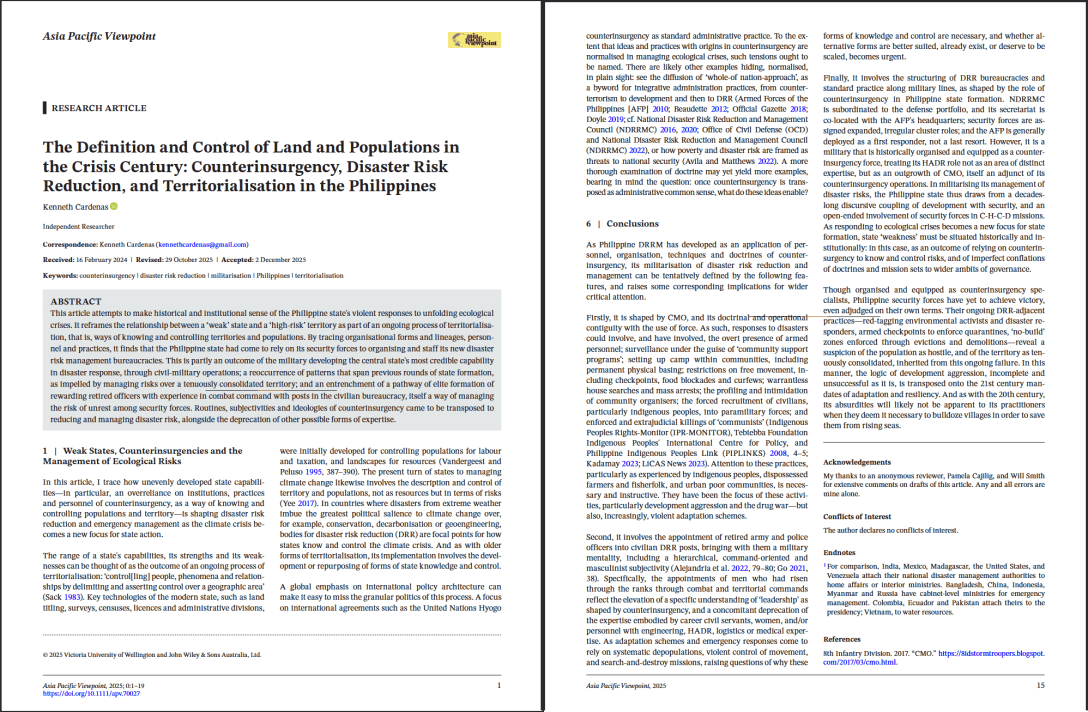
The definition and control of land and populations in the crisis century

Counterinsurgency, disaster risk reduction, and territorialisation in the Philippines

This article appears in a special issue of Asia Pacific Viewpoint on the theme More-than-complex: Governance and place in Philippine disaster management.

It is the final form of work I had previously presented at the Governing Complex Disasters in Southeast Asia workshop in 2023.
Read the full article here.

Abstract

This article attempts to make historical and institutional sense of the Philippine state’s violent responses to unfolding ecological crises. It reframes the relationship between a ‘weak’ state and a ‘high-risk’ territory as part of an ongoing process of territorialisation, that is, ways of knowing and controlling territories and populations. By tracing organisational forms and lineages, personnel and practices, it finds that the Philippine state had come to rely on its security forces to organising and staff its new disaster risk management bureaucracies. This is partly an outcome of the military developing the central state’s most credible capability in disaster response, through civil-military operations; a reoccurrence of patterns that span previous rounds of state formation, as impelled by managing risks over a tenuously consolidated territory; and an entrenchment of a pathway of elite formation of rewarding retired officers with experience in combat command with posts in the civilian bureaucracy, itself a way of managing the risk of unrest among security forces. Routines, subjectivities and ideologies of counterinsurgency came to be transposed to reducing and managing disaster risk, alongside the deprecation of other possible forms of expertise.

Territorialization and risk management in the Philippines

On the definition and control of land and populations in the crisis century

I will be presenting this paper at Governing Complex Disasters in Southeast Asia on 7 October 2023.

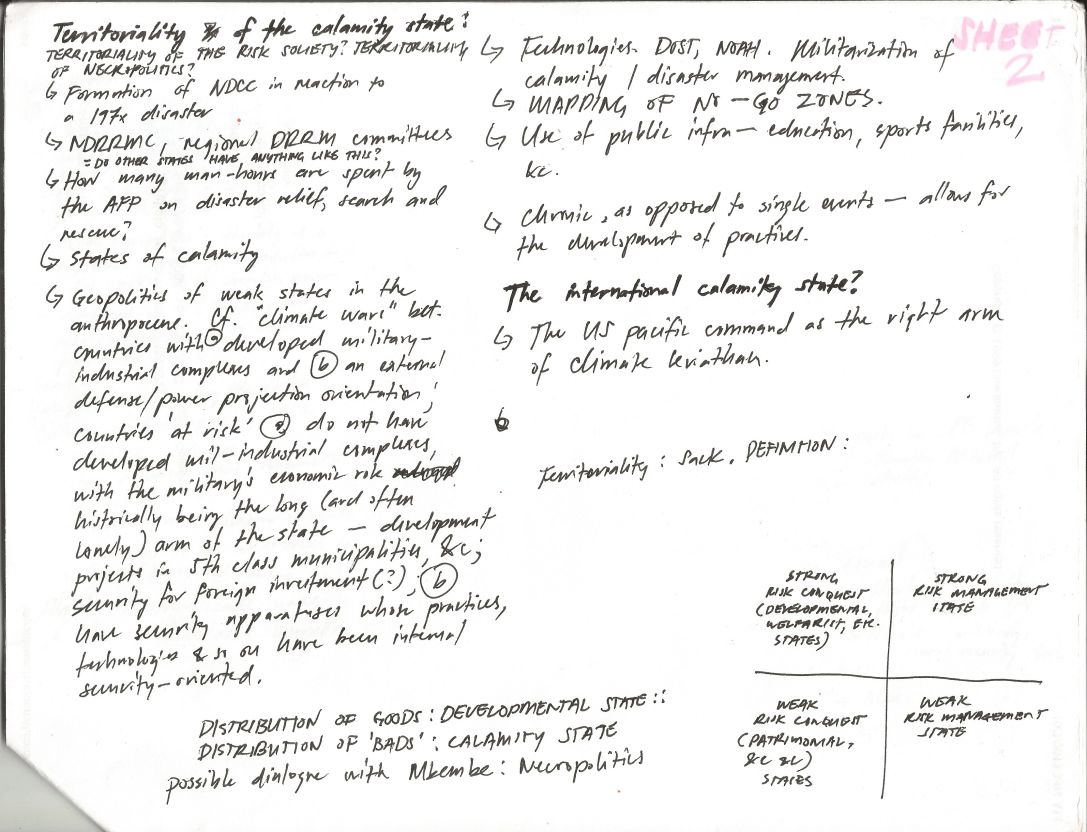
The states which exercise control over regions deemed at highest risk from climate change are, with a few exceptions, ‘weak’. In contrast to the great powers that are seen to be embroiled in climate wars, climate coloniality, or climate engineering, they do not have well-developed military-industrial complexes. They cannot project power far beyond their borders, and they have neither the personnel nor materiel to reshape the climate. Instead, their security apparatuses have historically been oriented toward internal threats, with a political-economic role limited to securing territories for ‘development’. But as complex emergencies become more important threats to these states, and as their militaries become embroiled in disaster response, resiliency efforts, and other operations other than war: how might practices initially developed to pacify unruly populations and to exert control over resources translate into new battlespaces involving environmental, public health, and urban planning risks?

This paper is an attempt at stating this question through the Philippines’ experiences with disasters in the early 21st century. Beginning with Typhoon Ondoy in 2009, and leading up to the Covid-19 pandemic, I consider how a ‘weak’ state exercised control over a ‘high-risk’ territory. I draw from Beck in framing 21st century complex disasters as embodying a shift from the first modernity of exploiting and distributing resources, to the second modernity of managing anthropogenic, catastrophic risks, and from Vandergeest and Peluso to conceptualize the state’s relationship with its land and people as a process of territorialization, a process which shapes the state’s practices of defining and controlling its territory. I propose that for the Philippine state, its reliance on militarized internal security operations to define and control the land and people within its territory, and on military personnel for staffing its civil works, environmental, and disaster management cabinet offices, had led it to rely on the personnel, rhetoric, and technologies of counterinsurgency to manage complex emergencies.

Energy after the new strongmen:

Notes for the next revolution

I will be presenting this paper at Dynamics of Change and Continuity in Philippine Political Economy: Martial Law and the Marcos Restoration on 24 February 2023.

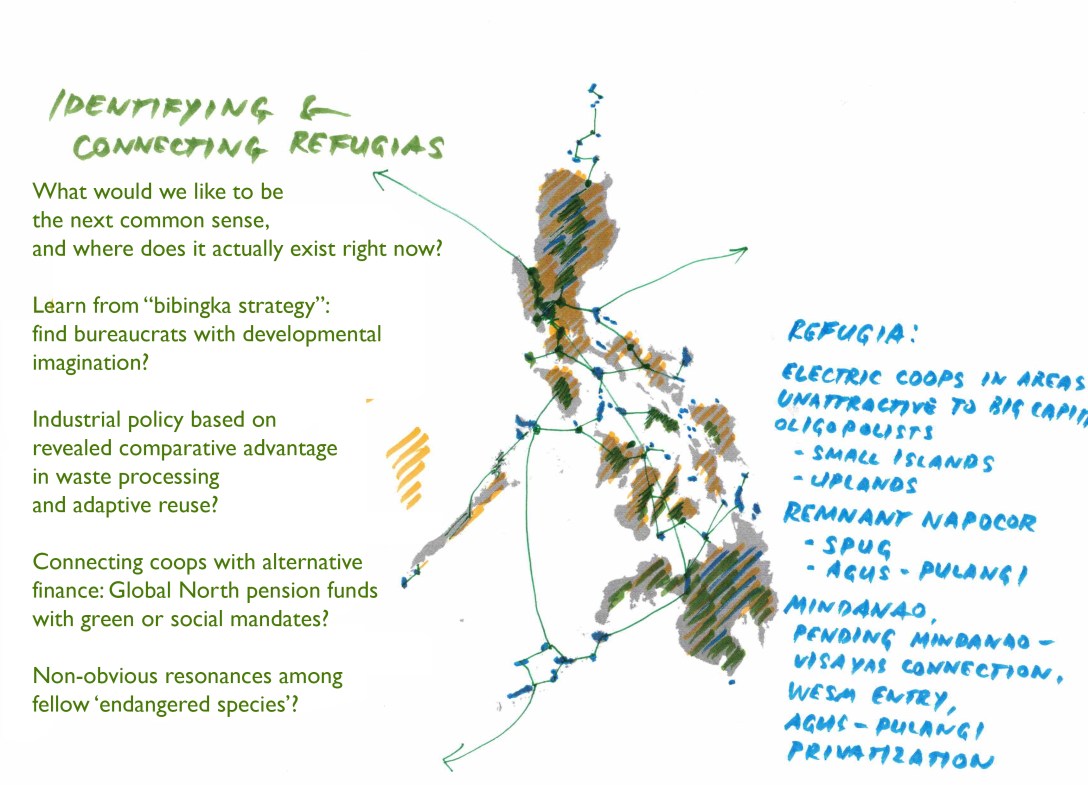
Energy industry reform was one of the defining features of the Edsa Republic’s political economy. It involved the largest privatizations, the largest flows of fresh investment, and the most profitable arms of the largest Philippine conglomerates. As a marquee policy, it also offered a way for successive post-Marcos administrations to signal their commitment to their creditors, repudiate the state-directed orthodoxy of 20th century development thinking, and experiment with a doctrinaire form of neoliberalism.

Yet market rule broke many of its promises. Monopolization, high prices, and supply shortfalls remain, or have deepened. In abandoning grand, strategic public investment, and in prioritizing investor sentiment and creditworthiness over the quality and price of a modernizing good, energy industry reform saw neoliberalism at the household level, and likely contributed to nostalgia for the megaproject-focused approach last seen under the Bagong Lipunan.

This paper articulates a refusal against both the neoliberalization of energy under the Edsa Republic, and the surrender to “political will”, with its attendant risk of crony capitalism and authoritarianism, pushed by the Philippines’ new strongmen. I argue that electrification uniquely offers embedded lessons for disentangling public investment and commons formation from authoritarianism, debt traps, and development aggression. By listening to the expertise that had been cultivated within Napocor in the late 20th century, and in electric cooperatives in the early 21st, and by anticipating energy transitions and crises in the medium-term future, I aim to recuperate a latent developmentalism within the Philippine energy industry as a reservoir of possibility for the next revolution. I pay specific attention to efficiencies that cannot be discovered and/or distorted by the market, and to forms of resistance to centralized power that inhere within the Philippine energy landscape.