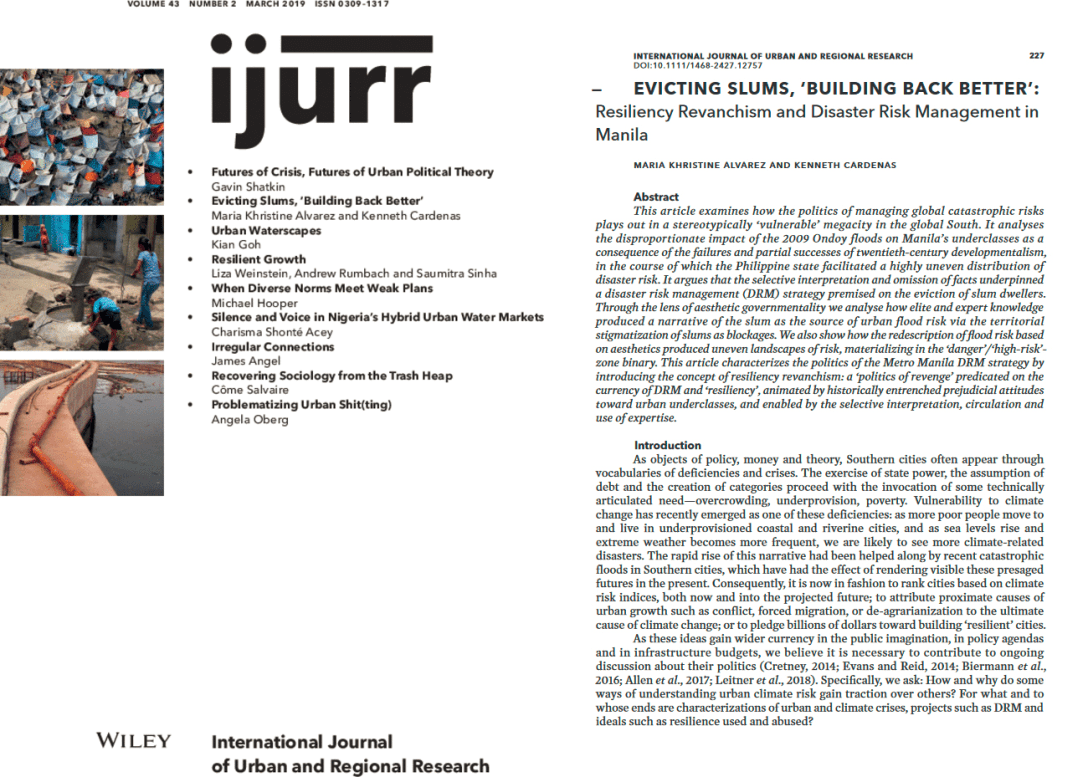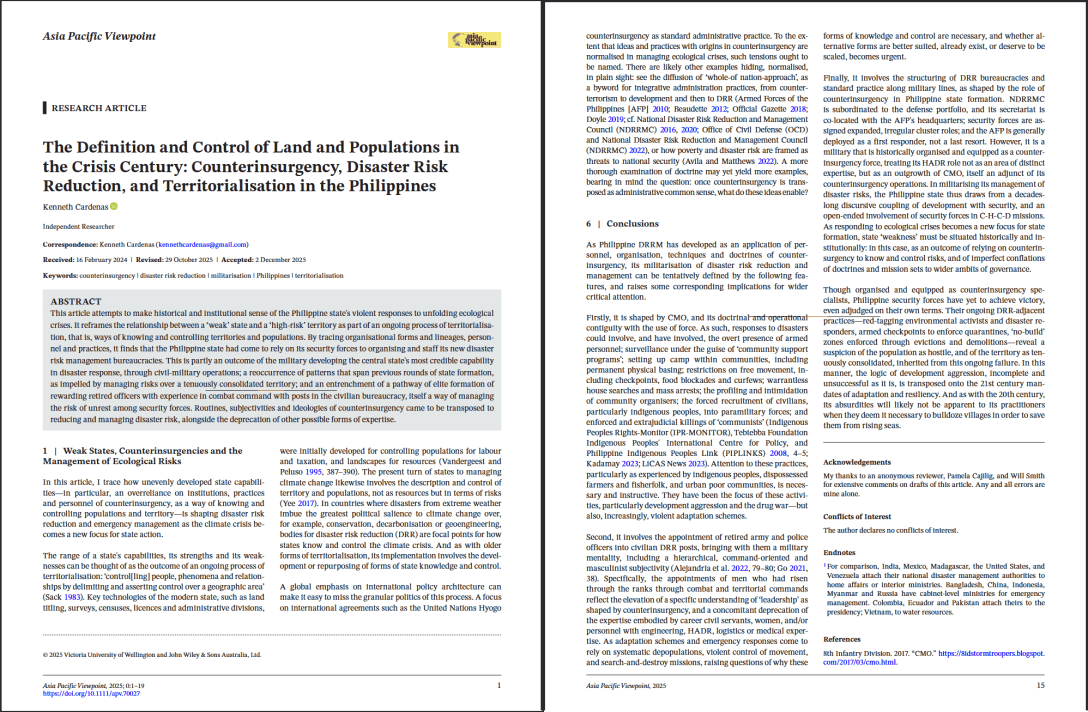
The definition and control of land and populations in the crisis century

Counterinsurgency, disaster risk reduction, and territorialisation in the Philippines

This article appears in a special issue of Asia Pacific Viewpoint on the theme More-than-complex: Governance and place in Philippine disaster management.

It is the final form of work I had previously presented at the Governing Complex Disasters in Southeast Asia workshop in 2023.
Read the full article here.

Abstract

This article attempts to make historical and institutional sense of the Philippine state’s violent responses to unfolding ecological crises. It reframes the relationship between a ‘weak’ state and a ‘high-risk’ territory as part of an ongoing process of territorialisation, that is, ways of knowing and controlling territories and populations. By tracing organisational forms and lineages, personnel and practices, it finds that the Philippine state had come to rely on its security forces to organising and staff its new disaster risk management bureaucracies. This is partly an outcome of the military developing the central state’s most credible capability in disaster response, through civil-military operations; a reoccurrence of patterns that span previous rounds of state formation, as impelled by managing risks over a tenuously consolidated territory; and an entrenchment of a pathway of elite formation of rewarding retired officers with experience in combat command with posts in the civilian bureaucracy, itself a way of managing the risk of unrest among security forces. Routines, subjectivities and ideologies of counterinsurgency came to be transposed to reducing and managing disaster risk, alongside the deprecation of other possible forms of expertise.

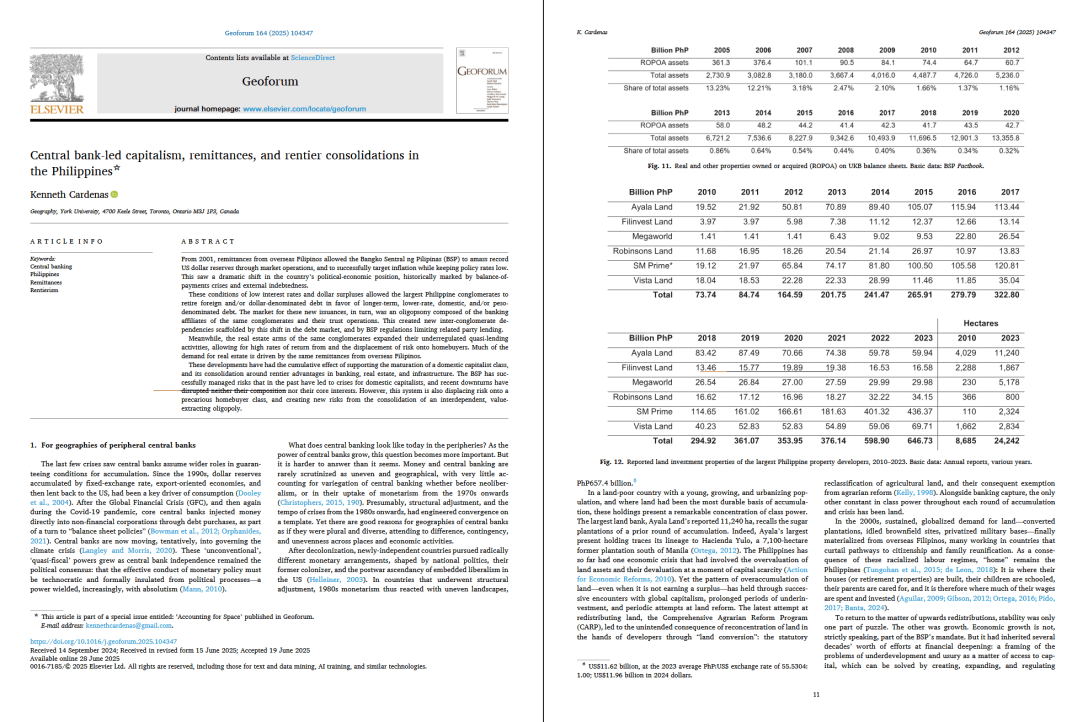
Central bank-led capitalism, remittances, and rentier consolidations in the Philippines

This article appears in a special issue of Geoforum on the theme Accounting for Space.

It is the final form of work I had previously presented at the 2025 Annual AAG Meeting in Detroit, and at the Accounting for Space: A critical accounting / critical geography mini-conference in 2023.

Read the full article here.

Highlights

  • From 2001, remittances put the Bangko Sentral ng Pilipinas (BSP) in a central role in reshaping the Philippine economy.
  • The BSP’s able management of monetary policy and banking supervision oversaw a period of exceptional growth and stability.
  • Philippine conglomerates with interests in real estate, infrastructure, and banking consolidated their position.
  • New concentrations of risk have arisen from changes in the debt patterns among these conglomerates.
  • Shadow banking practices by their real estate subsidiaries have also displaced risk onto homebuyers.

Abstract

From 2001, remittances from overseas Filipinos allowed the Bangko Sentral ng Pilipinas (BSP) to amass record US dollar reserves through market operations, and to successfully target inflation while keeping policy rates low. This saw a dramatic shift in the country’s political-economic position, historically marked by balance-of-payments crises and external indebtedness.

These conditions of low interest rates and dollar surpluses allowed the largest Philippine conglomerates to retire foreign and/or dollar-denominated debt in favor of longer-term, lower-rate, domestic, and/or peso-denominated debt. The market for these new issuances, in turn, was an oligopsony composed of the banking affiliates of the same conglomerates and their trust operations. This created new inter-conglomerate dependencies scaffolded by this shift in the debt market, and by BSP regulations limiting related party lending.

Meanwhile, the real estate arms of the same conglomerates expanded their underregulated quasi-lending activities, allowing for high rates of return from and the displacement of risk onto homebuyers. Much of the demand for real estate is driven by the same remittances from overseas Filipinos.

These developments have had the cumulative effect of supporting the maturation of a domestic capitalist class, and its consolidation around rentier advantages in banking, real estate, and infrastructure. The BSP has successfully managed risks that in the past have led to crises for domestic capitalists, and recent downturns have disrupted neither their composition nor their core interests. However, this system is also displacing risk onto a precarious homebuyer class, and creating new risks from the consolidation of an interdependent, value-extracting oligopoly.

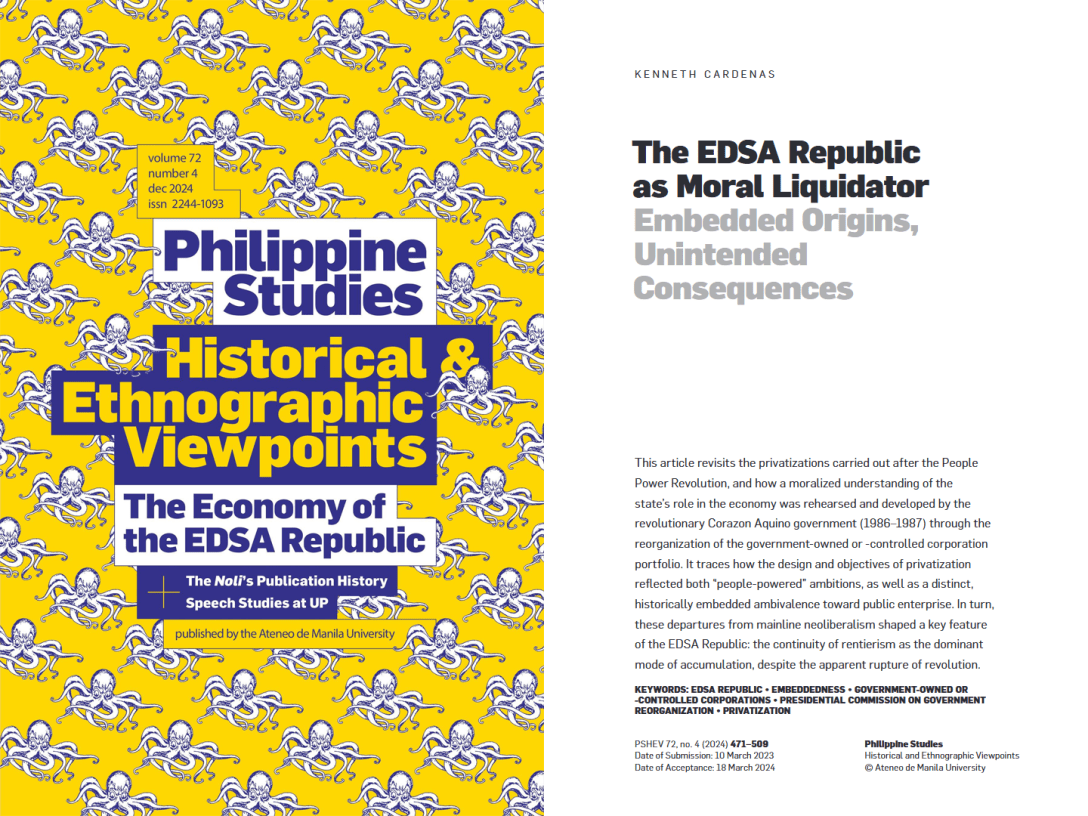
The EDSA Republic as moral liquidator

Embedded origins, unintended consequences

This article appears in Vol. 72, no. 4 of Philippine Studies: Historical and Ethnographic Viewpoints. It builds on a chapter from my PhD dissertation, and from work I had presented at the 2024 Association for Asian Studies annual conference in Seattle, and the 5th Philippine Studies conference in Japan in 2022.

This article revisits the privatizations carried out after the People Power Revolution, and how a moralized understanding of the state’s role in the economy was rehearsed and developed by the revolutionary Corazon Aquino government (1986–1987) through the reorganization of the government-owned or -controlled corporation portfolio. It traces how the design and objectives of privatization reflected both “people-powered” ambitions, as well as a distinct, historically embedded ambivalence toward public enterprise. In turn, these departures from mainline neoliberalism shaped a key feature of the EDSA Republic: the continuity of rentierism as the dominant mode of accumulation, despite the apparent rupture of revolution.