From microseasons to this millennium
Open file no. 61, began 4 May 2025
Stop 1: Playground
Alternative frames of reference, for space and also for time
On Indigenous histories of Mississauga
Mississaugas of the Credit First Nation: Treaty Lands & Territory.
Native Land Digital. “Native Land is an app to help map Indigenous territories, treaties, and languages.”
Eagle Spirits of the Great Waters
On paying attention, and traveling deep not far
“It often happens in the city that we encounter some small anomaly in the regular grid of city streets – a curve, a wiggle, a dead end street that seems to be there for no reason. This usually happens as a ripple of awareness, barely there, and we quickly go on to other things, accepting that this is “just the way it is”. In Toronto, it turns out that these little perturbations of the grid are actually deeply meaningful symptoms of a buried past: a landscape of deep ravines, bubbling brooks and primordial forest that has been obliterated by the building of the city, as well as even older deeper stories of great ice fields, of glacial lakes that formed as the ice melted, of the ancient rocks that lie beneath the work of the glaciers, a romantic and fascinating tale of the past landscapes of the city.”
“Buried rivers flow under Canadian cities, hidden in a labyrinth of tunnels and sewer pipes. Will we revive them or let the waterways fade from memory?”
Love in a time of terror. Barry Lopez on Lit Hub, 7 August 2020
“I’ve felt for a long time that the great political questions of our time—about violent prejudice, global climate change, venal greed, fear of the Other—could be addressed in illuminating ways by considering models in the natural world. Some consider it unsophisticated to explore the nonhuman world for clues to solving human dilemmas, and wisdom’s oldest tool, metaphor, is often regarded with wariness, or even suspicion in my culture. But abandoning metaphor entirely only paves the way to the rigidity of fundamentalism.”
* * *
Stop 2: Park bench
Aids for paying attention
Native Tree Leaves in English, French, and Anishinaabemowin from University of Guelph
Merlin Bird ID app: “Sound ID listens to the birds around you and shows real-time suggestions for who’s singing. Compare your recording to the songs and calls in Merlin to confirm what you heard. Sound ID works completely offline, so you can identify birds you hear no matter where you are.”
Seek app: “Found a mushroom, flower, or bug, and not sure what it is? Open up the Seek camera to see if it knows!
“Drawing from millions of wildlife observations on iNaturalist, Seek shows you lists of commonly recorded insects, birds, plants, amphibians, and more in your area.”
Some essays on paying attention
A single small map is enough for a lifetime. Alastair Humphrey on Noema Magazine, 23 January 2024
“Once I can put a name to something, like a bird or tree, I seem to come across it more often, and I also appreciate it more for knowing the word. As Robert Macfarlane wrote in “Landmarks,” “Language deficit leads to attention deficit. As we further deplete our ability to name, describe and figure particular aspects of our places, our competence for understanding and imagining possible relationships with non-human nature is correspondingly depleted.”
Forget the four seasons: how embracing 72 Japanese ‘micro-seasons’ could change your garden (and your life). Natalie Leon on The Guardian, 11 May 2024.
“When we recalibrate our lives by tuning into nature and training ourselves to notice, for example, the slightest changes in the colours of the leaves or the fronds of a fern unfurling, a new world opens up.”
There is knowledge in the land as well as in ourselves. Andrew Kirkpatrick on Psyche, 8 April 2025
“Central to the seasonal knowledge of the Yarralin people is the idea that ‘separate but simultaneous events stand in a communicative relationship to each other.’ For instance, one type of fly, when it bites you, is ‘telling you that [crocodile] eggs are ready’, while another type of biting fly ‘tells you that the bush plums are ready’. On this understanding, events in nature are neither isolated nor meaningless, but rather encoded with a kind of call-and-response rhythm that conveys knowledge across a wider ‘system’ of nature.”
* * *
Stop 3: Ruins on Given Road
Indigenous site upstream: the Antrex site
An Indigenous village lies buried under Mississauga. What the city is doing to commemorate it. Paula Duatschek, CBC News, 20 February 2022
Ask a Historian: Investigating the Antrex archeological site. John Dunlop, interviewed by Matthew Wilkinson, Heritage Mississauga, 28 April 2022.
Ruins in Richard Jones Park
Hiking the GTA blog: Given Road – Mississauga
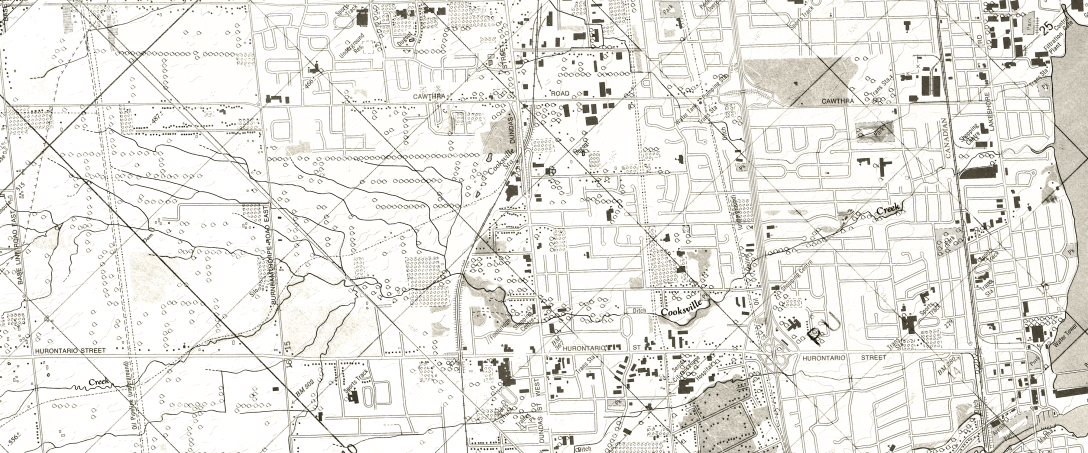
Topographic maps
Digital Topographic Raster Maps, 1944 – 2012. Government of Canada.
As far as I am able to tell, the last topographic map at a 1:25 000 scale produced by the Federal Government for the Mississauga area was in 1973. In my experience, finding the specific sheet name for any given area can take a bit of digging. I am happy to help.
Pre-settlement tree cover map
Gleaning from archeological reports
* * *
Stop 4: Sewerage, stormwater, flooding
Hiking in the GTA: Cooksville Creek
Mississauga’s stormwater infrastructure management important in historic 100-year storms. City of Mississauga press release, 19 August 2024.
Mississauga Valley stormwater management facility. City of Mississauga project information page.
* * *
Stop 5: Mississauga Valleys Park
On an alternative, actually-existing Mississauga
Campbell MacDiarmid on The Guardian, on Wolf Ruck: The gardener who took a Canadian city to court for the right to not mow his lawn.
“Most mornings, Wolf Ruck walks the mown paths in his yard in Mississauga, Ontario, watching for insects landing on the goldenrod, birds feeding on native seed heads, and chipmunk kits playing in the tall grass.
“The septuagenarian artist, film-maker and former Olympic canoeist began rewilding his garden with native plants three years ago, as part of a growing movement across Canada towards replacing water-thirsty lawns with “naturalised gardens”.”
Roll Cooksville and their Slow Rolls
“The Mississauga Cycles project started in 2019 as a joint collaboration between Peel Multicultural Council and CultureLink. Mississauga Cycles builds on the success of other Bike Hubs established by CultureLink in the GTA, connecting newcomers to their new community by bike. In 2023, Peel Multicultural Council became the lead for this program, with PMC staff leading programming throughout the year, including in winter for the first time.”
“The Cooksville Sustainable Neighbourhood Action Plan (SNAP) is a plan that was developed with your community to make Cooksville Creek and the surrounding neighbourhood healthier and ready for a changing climate.”
“Heart Comonos is people coming together in the Cooksville-Mississauga and surrounding area to share their ideas, gifts, skills, knowledge and life experiences. We partner with individuals and organizations to create projects and activities that support the multiple dimensions of personal and community wellness.” See their events list.
On immigrant communities along Cooksville Creek
Haneen Dalla-Ali: Tracings: Unraveling home in the diaspora
On imagining future green networks
Document Library for Mississauga Official Plan 2051
Natasha O’Neill on The Pointer: Britannia Farm – Mississauga’s hidden jewel
Urban Strategies Inc: Britannia Farm Master Plan refresh
The Credit Valley Trail. “The Credit Valley Trail will be a 100 km pathway through the Credit River Valley – from the headwaters in Orangeville to Lake Ontario in Mississauga – connecting people to nature, cultural experiences, Indigenous heritage and the sustaining waters of the Credit River.”
* * *
Stop 6: Glacial Lake Iroquois
Lost Rivers: Lake Iroquois and its shore cliff or bluff
* * *
Stop 7: Oldest black walnut in Mississauga City Centre
John K. Samson – The Oldest Oak at Brookside
 Kenneth Cardenas