Filipiniana collection development at York University, 2023–2024

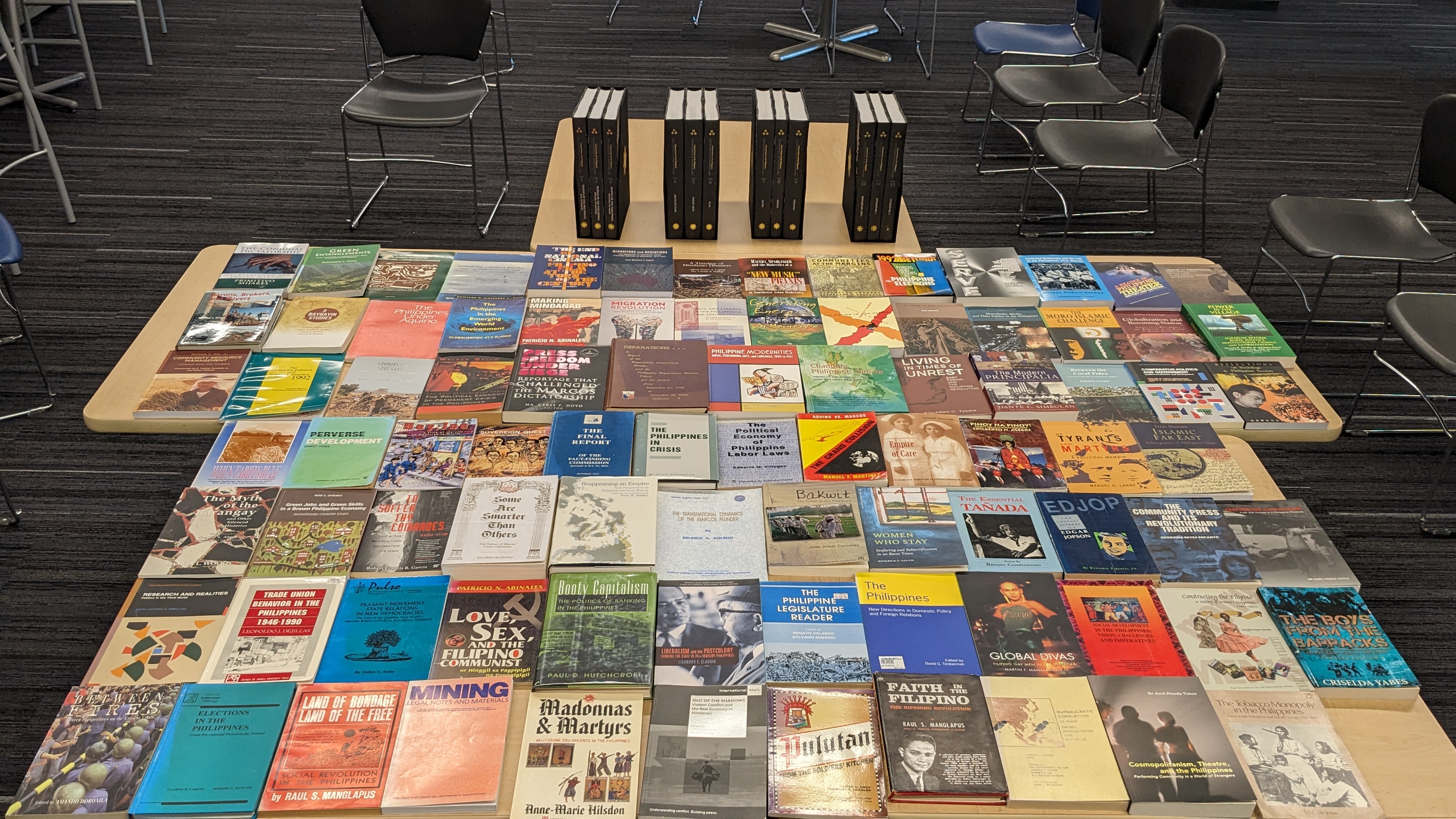
For the Filipiniana collection development project of the Philippine Studies Group at York University, I coordinated the acquisition of 108 titles for donation to York University Libraries. This project was part of a grant from the Philippine government to enhance academic and research collaborations between York and Philippine universities.

Update, 4 March 2025: read the final report here.

A full list of titles acquired is available here. YCAR’s press release here.

We focused on titles that fell outside YUL’s usual acquisition channels: titles older than five years, from presses without Canadian distribution channels. Some highlights include 31 titles from the University of the Philippines Press, 11 from Ateneo de Manila University Press, and 5 from Anvil Publishing. We acquired a full set of the second edition of the Encyclopedia of Philippine Arts: its final print run before it shifted to an online-only model.

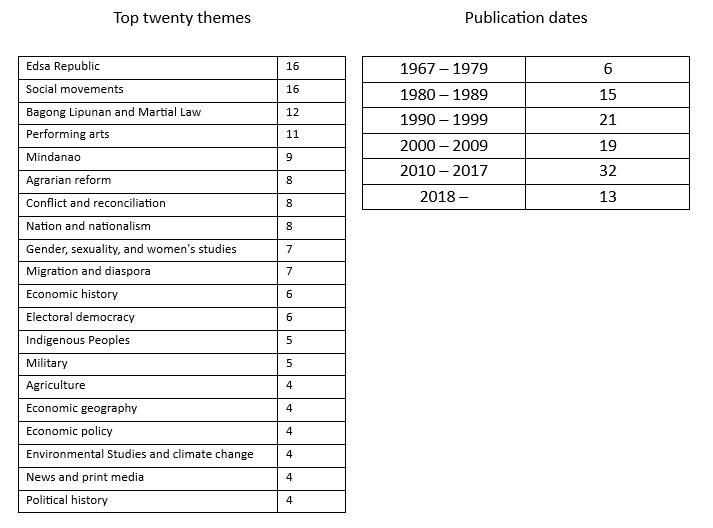
We sought to reflect the strengths and interests of York’s Philippine Studies community: performing arts, gender, sexuality, and women’s studies, economic history and geography, and environmental studies and climate change. We also tried to fill some gaps in York’s current collection with titles on social movements, Mindanao, and conflict and reconciliation.
Continue reading “Filipiniana collection development at York University, 2023–2024”

Two premises

For political imagination, and for varieties of possibility

Open file no. 50, began 24 October 2023

Sa sandaling matutunan mo ang managinip nang lubusang gising,
na ibalanse ang kamalayan hindi sa talim ng pangangatwiran
ngunit sa dobleng katig ng katwiran at panaginip;
sa sandaling matutunan mo ito,
mabibitawan mo lamang ito sa oras na mabitawan mo
kung paano magisip.

Ursula K. Le Guin, Ang Salita Para Sa Daigdig Ay Gubat

Ang tunay na radikal ay ang gawing abot-kamay ang pag-asa,
hindi ang patunayan ang pagka-gipit.

Raymond Williams

As I wrap up my dissertation, and as I take part in conversations about energy transitions, alternative transnational economies and solidarities, and climate crisis responses other than war, I have found myself turning and returning to two premises. 

These arose as I came to my own understanding of how accumulation and class power had developed in the Philippines over five centuries of capitalist and colonial encounter.  

I am finding, again and again, that many analytical categories that had developed in response to realities found elsewhere have very limited usefulness here.  

This incongruency between concepts and realities is hinted at by the recurrent (evergreen?) mode of production debates within Philippine critical thought: is the Philippines a capitalist society, or is it semi-feudal, semi-colonial?  

Maybe it is both and neither: the debate continues because both descriptions help explain some features of the systems we wish to describe and resist. Yet neither does justice to life as it arises within, alongside, and outside these systems.  

If you and I agree, then we need to trace the reasons behind the poor conceptual fit.  

These two premises also arose out of wanting to make hope possible, not despair convincing. I want to react to the rigid radicalism and damage-based research that I keep running into—and keep reproducing, myself.

If the whole point of ‘theory’ is ‘seeing’, I would much rather now learn ways of seeing that open up rather than foreclose political imagination. Instead of learning how to see lack, I would rather learn how to see varieties of possibilityespecially in landscapes dismissed as wastelands.

If you and I agree, then we need to find a way to take part in conversations in a way that brings these abilities out—even among the most inflexible critical theory bores in our worlds.

Some rough, ongoing thoughts, under constant revision, shared here so we can pick up where we left off:

Continue reading “Two premises”

Kung Saan Man Tayo / Wherever We May Be

Kung Saan Man Tayo will be screened virtually by the Center for Southeast Asian Studies of University of Hawaiʻi at Mānoa from 4 to 9 February 2022.

In 2014, filmmaker Adrian Alarilla sent a camera on an eastbound circumnavigation of the world. The camera, named Enrique after Panglima Awang/Enrique of Malacca, was to tell the stories of seven overseas Filipinxs, as part of an ongoing corrective to the stories of conquest, plunder, and exploitation that begun five hundred years ago.

For a few weeks in the summer of 2014, while I was reading for my comprehensive exams, I hosted Enrique in Toronto, on the first stop of a journey that involved Paris, Tübingen, Bangkok, Singapore, and Melbourne.

Adrian wove these stories into Kung Saan Man Tayo, an 80-minute documentary released in 2021.

Continue reading “Kung Saan Man Tayo / Wherever We May Be”

Countermapping v. epistemicide:

On the limits of neoliberalism, financialization, and gentrification

I will be presenting this paper at the Counter-mapping the City International Virtual Conference, organized by the Counter-Mapping PH Network, on 15 March 2022.

Critical urban scholarship has an unstated canon. The core concepts of this canon had been developed in response to North/Western experiences by North/Western experts, have been circulated and universalized through knowledge practices with roots in Empire, and now exert a distortive influence on scholarship from and on, the global South.

In this paper I propose an epistemic sense of “countermapping”: naming the ways mundane practices of critical urban scholarship reinscribe the cartographic practices of Empire, and showing how key features of present landscapes of class power and dispossession may be better described by explicitly Southern modes of knowing.

Enclosed and deliberately-idled land is a persistent feature of urban Philippine landscapes. These are dispossessions: their presence means land is withdrawn from beneficial use, and they contribute to artificially-high land prices. 
Continue reading “Countermapping v. epistemicide:”