Le Guin: piling talata

Le Guin: selected passages
Paminsanang pagsasalin / Occasional translations, no. 1

Sa sandaling matutunan mo ang managinip nang lubusang gising,
na ibalanse ang kamalayan hindi sa talim ng pangangatwiran
ngunit sa dobleng katig ng katwiran at panaginip;
sa sandaling matutunan mo ito,
mabibitawan mo lamang ito sa oras na mabitawan mo
kung paano magisip.

Ursula K. Le Guin, Ang Ngalan ng Sanlibutan Ay Gubat

Once you have learned to do your dreaming wide awake,
to balance your sanity not on the razor’s edge of reason
but on the double support, the fine balance, of reason and dream;
once you have learned that,
you cannot unlearn it any more than you can unlearn
to think.

Ursula K. Le Guin, The Word for World is Forest

At ang baylan at ang magdaragat ay hindi nalalayo;
kapwang naghahabi ng kapangyarihan ng langit at laot,

hinihubog ang hangin sa habi at haplos at hawak,
nilalayag papalapit kung ano ang dating malayo.

Ursula K. Le Guin, Ang Pinakamalayong Baybayin

“And mage and sailor are not so far apart;
both work with the powers of sky and sea,
and bend great winds to the uses of their hands,
bringing near what was remote.”

Ursula K. Le Guin, The Farthest Shore

“We must systematically ‘de-Marcosify’ Philippine society”

On the embedded precursors and unintended consequences of Edsa Republic privatizations

I presented this paper at the 2024 Association for Asian Studies annual conference in Seattle, and builds on my 2022 presentation at the Philippine Studies Conference in Japan. A version of it was published on Philippine Studies: Historical and Ethnographic Viewpoints as The EDSA Republic as moral liquidator: Embedded origins, unintended consequences.

Access the full article through Project Muse here.

This article revisits the privatizations carried out after the Edsa Revolution, emphasizing historical context, the agency of Filipinos working within technocratic and bureaucratic spaces, and institutional path-dependence. It shows how a moralized understanding of the state’s role in the economy was rehearsed and developed by the revolutionary Aquino government (1986–7) through the reorganization of the Government-Owned or Controlled Corporation (GOCC) portfolio. Focusing on the Presidential Commission on Government Reorganization (PCGR), it traces how the design and objectives of privatization reflected both “people-powered” ambitions, as well as a distinct, historically-embedded ambivalence toward public enterprise. In turn, these departures from mainline neoliberalism shaped a key feature of the Edsa Republic: the continuity of rentierism as the dominant mode of accumulation, despite the apparent rupture of revolution.

My thanks to my co-panellists Inigo Chotirawe Acosta, Johnny Bassett, and Claire Cororaton, and to our reactor, Dr. Taihei Okada.

Two premises

For political imagination, and for varieties of possibility

Open file no. 50, began 24 October 2023

Sa sandaling matutunan mo ang managinip nang lubusang gising,
na ibalanse ang kamalayan hindi sa talim ng pangangatwiran
ngunit sa dobleng katig ng katwiran at panaginip;
sa sandaling matutunan mo ito,
mabibitawan mo lamang ito sa oras na mabitawan mo
kung paano magisip.

Ursula K. Le Guin, Ang Salita Para Sa Daigdig Ay Gubat

Ang tunay na radikal ay ang gawing abot-kamay ang pag-asa,
hindi ang patunayan ang pagka-gipit.

Raymond Williams

As I wrap up my dissertation, and as I take part in conversations about energy transitions, alternative transnational economies and solidarities, and climate crisis responses other than war, I have found myself turning and returning to two premises. 

These arose as I came to my own understanding of how accumulation and class power had developed in the Philippines over five centuries of capitalist and colonial encounter.  

I am finding, again and again, that many analytical categories that had developed in response to realities found elsewhere have very limited usefulness here.  

This incongruency between concepts and realities is hinted at by the recurrent (evergreen?) mode of production debates within Philippine critical thought: is the Philippines a capitalist society, or is it semi-feudal, semi-colonial?  

Maybe it is both and neither: the debate continues because both descriptions help explain some features of the systems we wish to describe and resist. Yet neither does justice to life as it arises within, alongside, and outside these systems.  

If you and I agree, then we need to trace the reasons behind the poor conceptual fit.  

These two premises also arose out of wanting to make hope possible, not despair convincing. I want to react to the rigid radicalism and damage-based research that I keep running into—and keep reproducing, myself.

If the whole point of ‘theory’ is ‘seeing’, I would much rather now learn ways of seeing that open up rather than foreclose political imagination. Instead of learning how to see lack, I would rather learn how to see varieties of possibilityespecially in landscapes dismissed as wastelands.

If you and I agree, then we need to find a way to take part in conversations in a way that brings these abilities out—even among the most inflexible critical theory bores in our worlds.

Some rough, ongoing thoughts, under constant revision, shared here so we can pick up where we left off:

Continue reading “Two premises”

Energy after the new strongmen:

Notes for the next revolution

I will be presenting this paper at Dynamics of Change and Continuity in Philippine Political Economy: Martial Law and the Marcos Restoration on 24 February 2023.

Energy industry reform was one of the defining features of the Edsa Republic’s political economy. It involved the largest privatizations, the largest flows of fresh investment, and the most profitable arms of the largest Philippine conglomerates. As a marquee policy, it also offered a way for successive post-Marcos administrations to signal their commitment to their creditors, repudiate the state-directed orthodoxy of 20th century development thinking, and experiment with a doctrinaire form of neoliberalism.

Yet market rule broke many of its promises. Monopolization, high prices, and supply shortfalls remain, or have deepened. In abandoning grand, strategic public investment, and in prioritizing investor sentiment and creditworthiness over the quality and price of a modernizing good, energy industry reform saw neoliberalism at the household level, and likely contributed to nostalgia for the megaproject-focused approach last seen under the Bagong Lipunan.

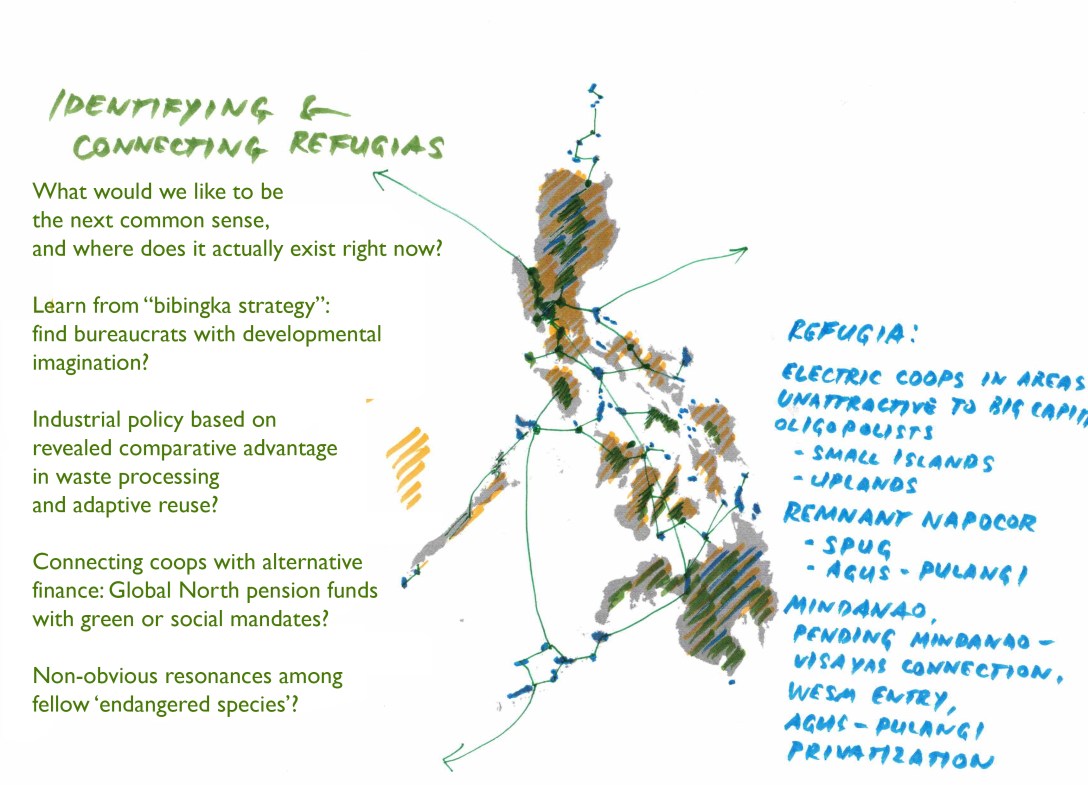
This paper articulates a refusal against both the neoliberalization of energy under the Edsa Republic, and the surrender to “political will”, with its attendant risk of crony capitalism and authoritarianism, pushed by the Philippines’ new strongmen. I argue that electrification uniquely offers embedded lessons for disentangling public investment and commons formation from authoritarianism, debt traps, and development aggression. By listening to the expertise that had been cultivated within Napocor in the late 20th century, and in electric cooperatives in the early 21st, and by anticipating energy transitions and crises in the medium-term future, I aim to recuperate a latent developmentalism within the Philippine energy industry as a reservoir of possibility for the next revolution. I pay specific attention to efficiencies that cannot be discovered and/or distorted by the market, and to forms of resistance to centralized power that inhere within the Philippine energy landscape.