Two premises

For political imagination, and for varieties of possibility

Open file no. 50, began 24 October 2023

Sa sandaling matutunan mo ang managinip nang lubusang gising,
na ibalanse ang kamalayan hindi sa talim ng pangangatwiran
ngunit sa dobleng katig ng katwiran at panaginip;
sa sandaling matutunan mo ito,
mabibitawan mo lamang ito sa oras na mabitawan mo
kung paano magisip.

Ursula K. Le Guin, Ang Salita Para Sa Daigdig Ay Gubat

Ang tunay na radikal ay ang gawing abot-kamay ang pag-asa,
hindi ang patunayan ang pagka-gipit.

Raymond Williams

As I wrap up my dissertation, and as I take part in conversations about energy transitions, alternative transnational economies and solidarities, and climate crisis responses other than war, I have found myself turning and returning to two premises. 

These arose as I came to my own understanding of how accumulation and class power had developed in the Philippines over five centuries of capitalist and colonial encounter.  

I am finding, again and again, that many analytical categories that had developed in response to realities found elsewhere have very limited usefulness here.  

This incongruency between concepts and realities is hinted at by the recurrent (evergreen?) mode of production debates within Philippine critical thought: is the Philippines a capitalist society, or is it semi-feudal, semi-colonial?  

Maybe it is both and neither: the debate continues because both descriptions help explain some features of the systems we wish to describe and resist. Yet neither does justice to life as it arises within, alongside, and outside these systems.  

If you and I agree, then we need to trace the reasons behind the poor conceptual fit.  

These two premises also arose out of wanting to make hope possible, not despair convincing. I want to react to the rigid radicalism and damage-based research that I keep running into—and keep reproducing, myself.

If the whole point of ‘theory’ is ‘seeing’, I would much rather now learn ways of seeing that open up rather than foreclose political imagination. Instead of learning how to see lack, I would rather learn how to see varieties of possibilityespecially in landscapes dismissed as wastelands.

If you and I agree, then we need to find a way to take part in conversations in a way that brings these abilities out—even among the most inflexible critical theory bores in our worlds.

Some rough, ongoing thoughts, under constant revision, shared here so we can pick up where we left off:

Continue reading “Two premises”
Energy after the new strongmen:

Notes for the next revolution

I will be presenting this paper at Dynamics of Change and Continuity in Philippine Political Economy: Martial Law and the Marcos Restoration on 24 February 2023.

Energy industry reform was one of the defining features of the Edsa Republic’s political economy. It involved the largest privatizations, the largest flows of fresh investment, and the most profitable arms of the largest Philippine conglomerates. As a marquee policy, it also offered a way for successive post-Marcos administrations to signal their commitment to their creditors, repudiate the state-directed orthodoxy of 20th century development thinking, and experiment with a doctrinaire form of neoliberalism.

Yet market rule broke many of its promises. Monopolization, high prices, and supply shortfalls remain, or have deepened. In abandoning grand, strategic public investment, and in prioritizing investor sentiment and creditworthiness over the quality and price of a modernizing good, energy industry reform saw neoliberalism at the household level, and likely contributed to nostalgia for the megaproject-focused approach last seen under the Bagong Lipunan.

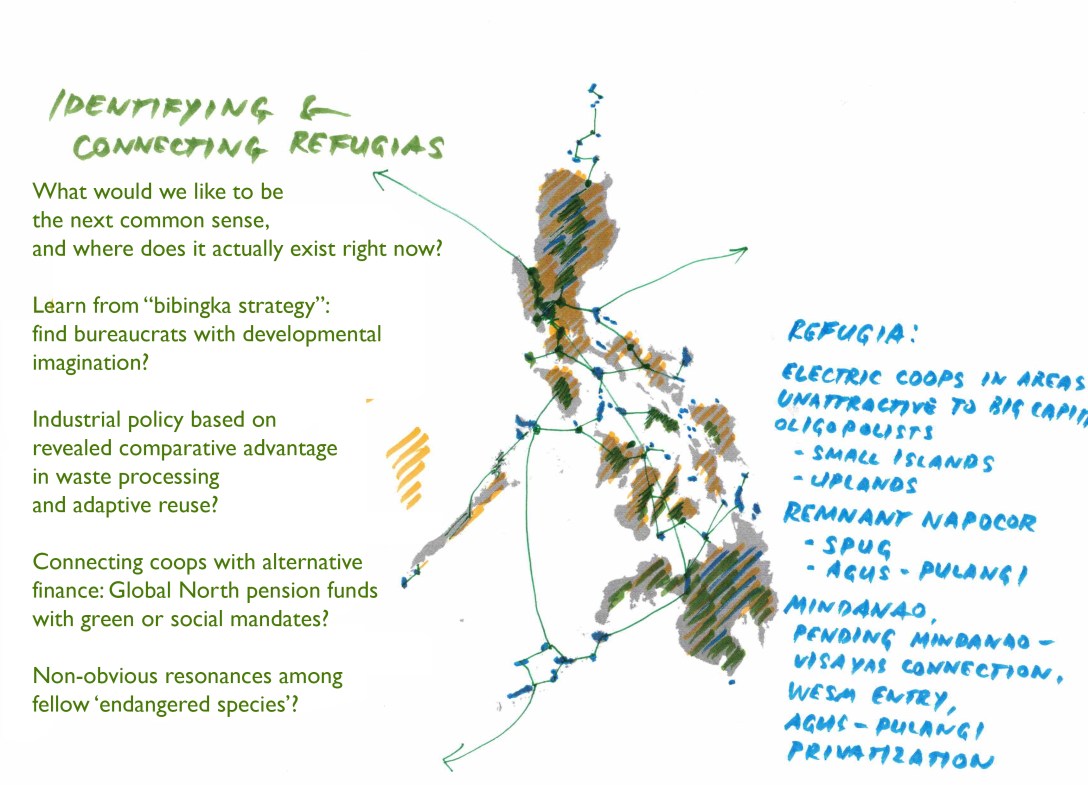
This paper articulates a refusal against both the neoliberalization of energy under the Edsa Republic, and the surrender to “political will”, with its attendant risk of crony capitalism and authoritarianism, pushed by the Philippines’ new strongmen. I argue that electrification uniquely offers embedded lessons for disentangling public investment and commons formation from authoritarianism, debt traps, and development aggression. By listening to the expertise that had been cultivated within Napocor in the late 20th century, and in electric cooperatives in the early 21st, and by anticipating energy transitions and crises in the medium-term future, I aim to recuperate a latent developmentalism within the Philippine energy industry as a reservoir of possibility for the next revolution. I pay specific attention to efficiencies that cannot be discovered and/or distorted by the market, and to forms of resistance to centralized power that inhere within the Philippine energy landscape.

Countermapping v. epistemicide:

On the limits of neoliberalism, financialization, and gentrification

I will be presenting this paper at the Counter-mapping the City International Virtual Conference, organized by the Counter-Mapping PH Network, on 15 March 2022.

Critical urban scholarship has an unstated canon. The core concepts of this canon had been developed in response to North/Western experiences by North/Western experts, have been circulated and universalized through knowledge practices with roots in Empire, and now exert a distortive influence on scholarship from and on, the global South.

In this paper I propose an epistemic sense of “countermapping”: naming the ways mundane practices of critical urban scholarship reinscribe the cartographic practices of Empire, and showing how key features of present landscapes of class power and dispossession may be better described by explicitly Southern modes of knowing.

Enclosed and deliberately-idled land is a persistent feature of urban Philippine landscapes. These are dispossessions: their presence means land is withdrawn from beneficial use, and they contribute to artificially-high land prices. 
Continue reading “Countermapping v. epistemicide:”