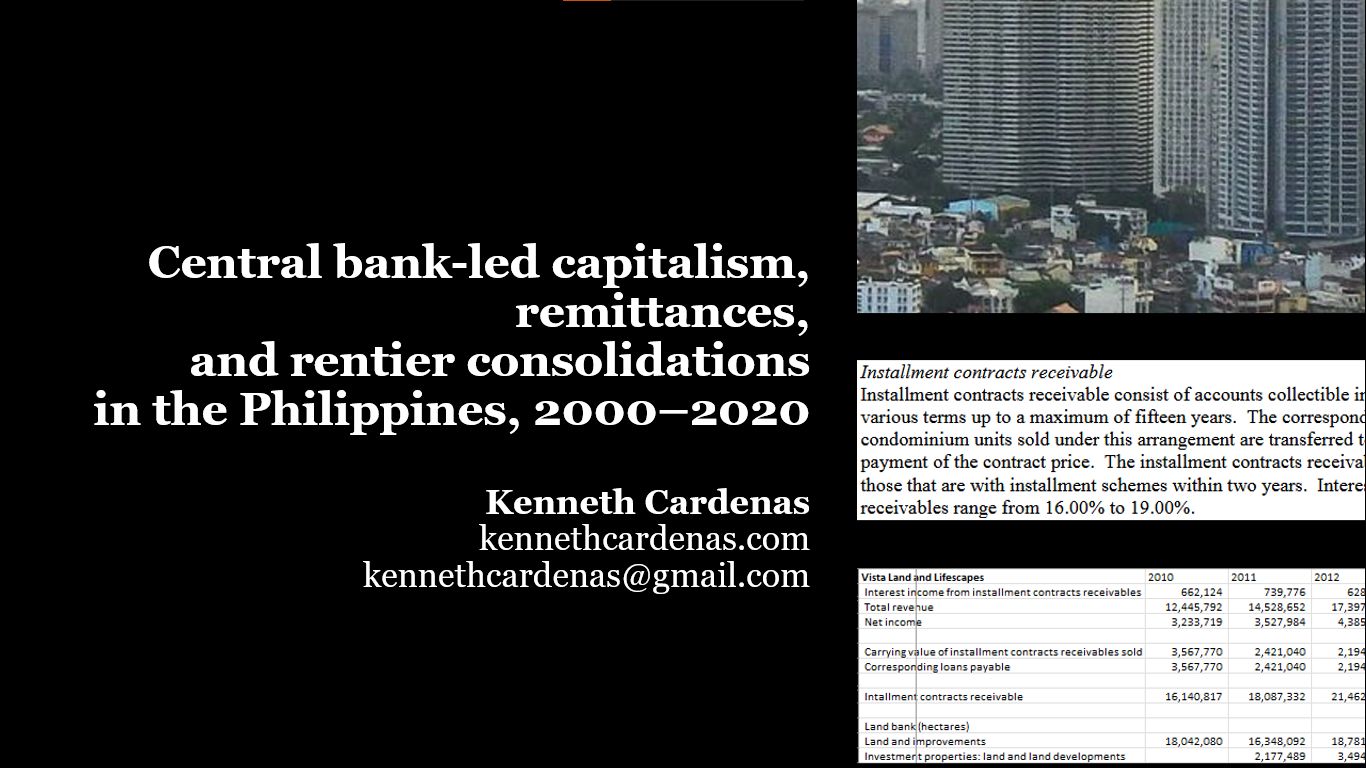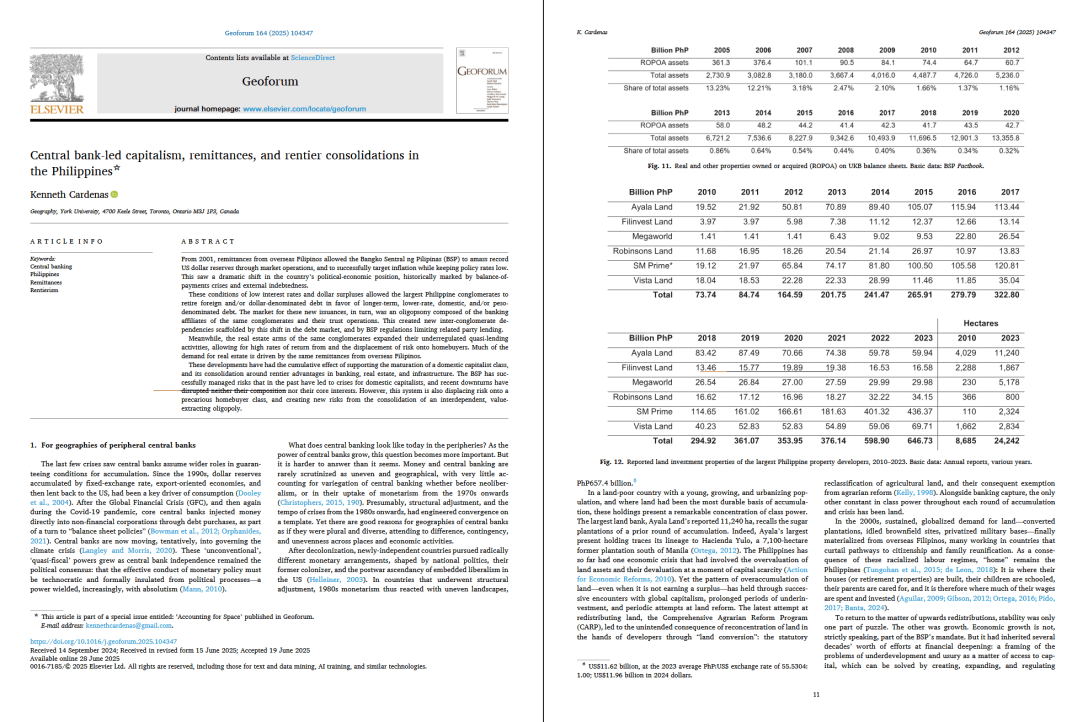
Central bank-led capitalism, remittances, and rentier consolidations in the Philippines

This article appears in a special issue of Geoforum on the theme Accounting for Space.

It is the final form of work I had previously presented at the 2025 Annual AAG Meeting in Detroit, and at the Accounting for Space: A critical accounting / critical geography mini-conference in 2023.
Read the full article here.

Highlights

  • From 2001, remittances put the Bangko Sentral ng Pilipinas (BSP) in a central role in reshaping the Philippine economy.
  • The BSP’s able management of monetary policy and banking supervision oversaw a period of exceptional growth and stability.
  • Philippine conglomerates with interests in real estate, infrastructure, and banking consolidated their position.
  • New concentrations of risk have arisen from changes in the debt patterns among these conglomerates.
  • Shadow banking practices by their real estate subsidiaries have also displaced risk onto homebuyers.

Abstract

From 2001, remittances from overseas Filipinos allowed the Bangko Sentral ng Pilipinas (BSP) to amass record US dollar reserves through market operations, and to successfully target inflation while keeping policy rates low. This saw a dramatic shift in the country’s political-economic position, historically marked by balance-of-payments crises and external indebtedness.

These conditions of low interest rates and dollar surpluses allowed the largest Philippine conglomerates to retire foreign and/or dollar-denominated debt in favor of longer-term, lower-rate, domestic, and/or peso-denominated debt. The market for these new issuances, in turn, was an oligopsony composed of the banking affiliates of the same conglomerates and their trust operations. This created new inter-conglomerate dependencies scaffolded by this shift in the debt market, and by BSP regulations limiting related party lending.

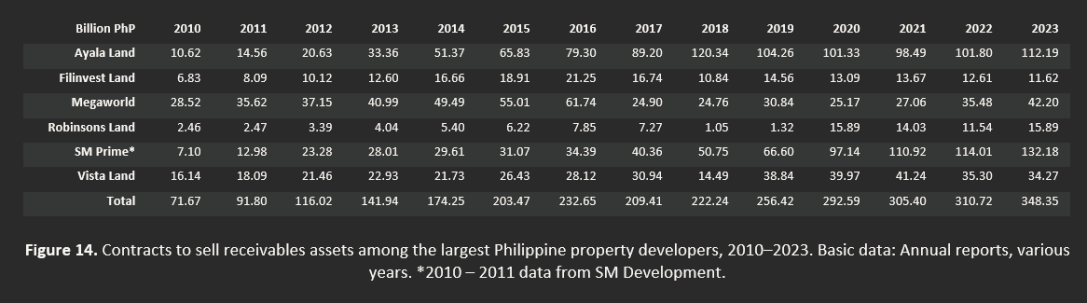
Meanwhile, the real estate arms of the same conglomerates expanded their underregulated quasi-lending activities, allowing for high rates of return from and the displacement of risk onto homebuyers. Much of the demand for real estate is driven by the same remittances from overseas Filipinos.

These developments have had the cumulative effect of supporting the maturation of a domestic capitalist class, and its consolidation around rentier advantages in banking, real estate, and infrastructure. The BSP has successfully managed risks that in the past have led to crises for domestic capitalists, and recent downturns have disrupted neither their composition nor their core interests. However, this system is also displacing risk onto a precarious homebuyer class, and creating new risks from the consolidation of an interdependent, value-extracting oligopoly.

The EDSA Republic as moral liquidator

Embedded origins, unintended consequences

This article appears in Vol. 72, no. 4 of Philippine Studies: Historical and Ethnographic Viewpoints. It builds on a chapter from my PhD dissertation, and from work I had presented at the 2024 Association for Asian Studies annual conference in Seattle, and the 5th Philippine Studies conference in Japan in 2022.

This article revisits the privatizations carried out after the People Power Revolution, and how a moralized understanding of the state’s role in the economy was rehearsed and developed by the revolutionary Corazon Aquino government (1986–1987) through the reorganization of the government-owned or -controlled corporation portfolio. It traces how the design and objectives of privatization reflected both “people-powered” ambitions, as well as a distinct, historically embedded ambivalence toward public enterprise. In turn, these departures from mainline neoliberalism shaped a key feature of the EDSA Republic: the continuity of rentierism as the dominant mode of accumulation, despite the apparent rupture of revolution.

Central bank-led capitalism, remittances, and rentier consolidations in the Philippines

I will be presenting this paper at the 2025 Annual AAG Meeting as part of a session titled Accounting for Space 2: The role of the state in financial infrastructures, and develops work I had first presented at Accounting for Space: A critical accounting / critical geography mini-conference, York University, 20 April 2023.

A final, peer reviewed form of this work is included in a special issue of Geoforum on the theme Accounting for Space.

Read the full article here.

From 2001, remittances from overseas Filipinos allowed the Bangko Sentral ng Pilipinas to amass record US dollar reserves through market operations, and to successfully target inflation while keeping policy rates low. This saw a dramatic shift in the country’s political-economic position, historically marked by balance-of-payments crises and external indebtedness.

These conditions of low interest rates and dollar surpluses allowed the largest Philippine conglomerates to retire foreign and/or dollar-denominated debt in favor of longer-term, lower-rate, domestic, and/or peso-denominated debt. The market for these new issuances, in turn, was an oligopsony composed of the banking affiliates of the same conglomerates and their trust operations. This created new inter-conglomerate dependencies scaffolded by this shift in the debt market, and by BSP regulations limiting related party lending.

Meanwhile, the real estate arms of the same conglomerates expanded their underregulated quasi-lending activities, allowing for high rates of return from and the displacement of risk onto homebuyers. Much of the demand for real estate is driven by the same remittances from overseas Filipinos.

These developments have had the cumulative effect of supporting the maturation of a domestic capitalist class, and its consolidation around rentier advantages in banking, real estate, and infrastructure. The BSP has successfully managed risks that in the past have led to crises for domestic capitalists, and recent downturns have disrupted neither their composition nor their core interests. However, this system is also displacing risk onto a precarious homebuyer class, and creating new risks from the consolidation of an interdependent, value-extracting oligopoly.

“We must systematically ‘de-Marcosify’ Philippine society”

On the embedded precursors and unintended consequences of Edsa Republic privatizations

I presented this paper at the 2024 Association for Asian Studies annual conference in Seattle, and builds on my 2022 presentation at the Philippine Studies Conference in Japan. A version of it was published on Philippine Studies: Historical and Ethnographic Viewpoints as The EDSA Republic as moral liquidator: Embedded origins, unintended consequences.

Access the full article through Project Muse here.

This article revisits the privatizations carried out after the Edsa Revolution, emphasizing historical context, the agency of Filipinos working within technocratic and bureaucratic spaces, and institutional path-dependence. It shows how a moralized understanding of the state’s role in the economy was rehearsed and developed by the revolutionary Aquino government (1986–7) through the reorganization of the Government-Owned or Controlled Corporation (GOCC) portfolio. Focusing on the Presidential Commission on Government Reorganization (PCGR), it traces how the design and objectives of privatization reflected both “people-powered” ambitions, as well as a distinct, historically-embedded ambivalence toward public enterprise. In turn, these departures from mainline neoliberalism shaped a key feature of the Edsa Republic: the continuity of rentierism as the dominant mode of accumulation, despite the apparent rupture of revolution.

My thanks to my co-panellists Inigo Chotirawe Acosta, Johnny Bassett, and Claire Cororaton, and to our reactor, Dr. Taihei Okada.