From 2001, remittances from overseas Filipinos allowed the Bangko Sentral ng Pilipinas to amass record US dollar reserves through market operations, and to successfully target inflation while keeping policy rates low. This saw a dramatic shift in the country’s political-economic position, historically marked by balance-of-payments crises and external indebtedness.
These conditions of low interest rates and dollar surpluses allowed the largest Philippine conglomerates to retire foreign and/or dollar-denominated debt in favor of longer-term, lower-rate, domestic, and/or peso-denominated debt. The market for these new issuances, in turn, was an oligopsony composed of the banking affiliates of the same conglomerates and their trust operations. This created new inter-conglomerate dependencies scaffolded by this shift in the debt market, and by BSP regulations limiting related party lending.
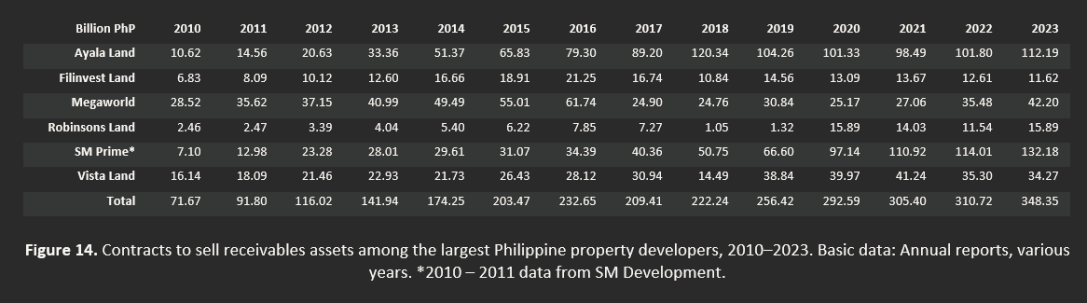
Meanwhile, the real estate arms of the same conglomerates expanded their underregulated quasi-lending activities, allowing for high rates of return from and the displacement of risk onto homebuyers. Much of the demand for real estate is driven by the same remittances from overseas Filipinos.
These developments have had the cumulative effect of supporting the maturation of a domestic capitalist class, and its consolidation around rentier advantages in banking, real estate, and infrastructure. The BSP has successfully managed risks that in the past have led to crises for domestic capitalists, and recent downturns have disrupted neither their composition nor their core interests. However, this system is also displacing risk onto a precarious homebuyer class, and creating new risks from the consolidation of an interdependent, value-extracting oligopoly.
On the embedded precursors and unintended consequences of Edsa Republic privatizations
This article revisits the privatizations carried out after the Edsa Revolution, emphasizing historical context, the agency of Filipinos working within technocratic and bureaucratic spaces, and institutional path-dependence. It shows how a moralized understanding of the state’s role in the economy was rehearsed and developed by the revolutionary Aquino government (1986–7) through the reorganization of the Government-Owned or Controlled Corporation (GOCC) portfolio. Focusing on the Presidential Commission on Government Reorganization (PCGR), it traces how the design and objectives of privatization reflected both “people-powered” ambitions, as well as a distinct, historically-embedded ambivalence toward public enterprise. In turn, these departures from mainline neoliberalism shaped a key feature of the Edsa Republic: the continuity of rentierism as the dominant mode of accumulation, despite the apparent rupture of revolution.
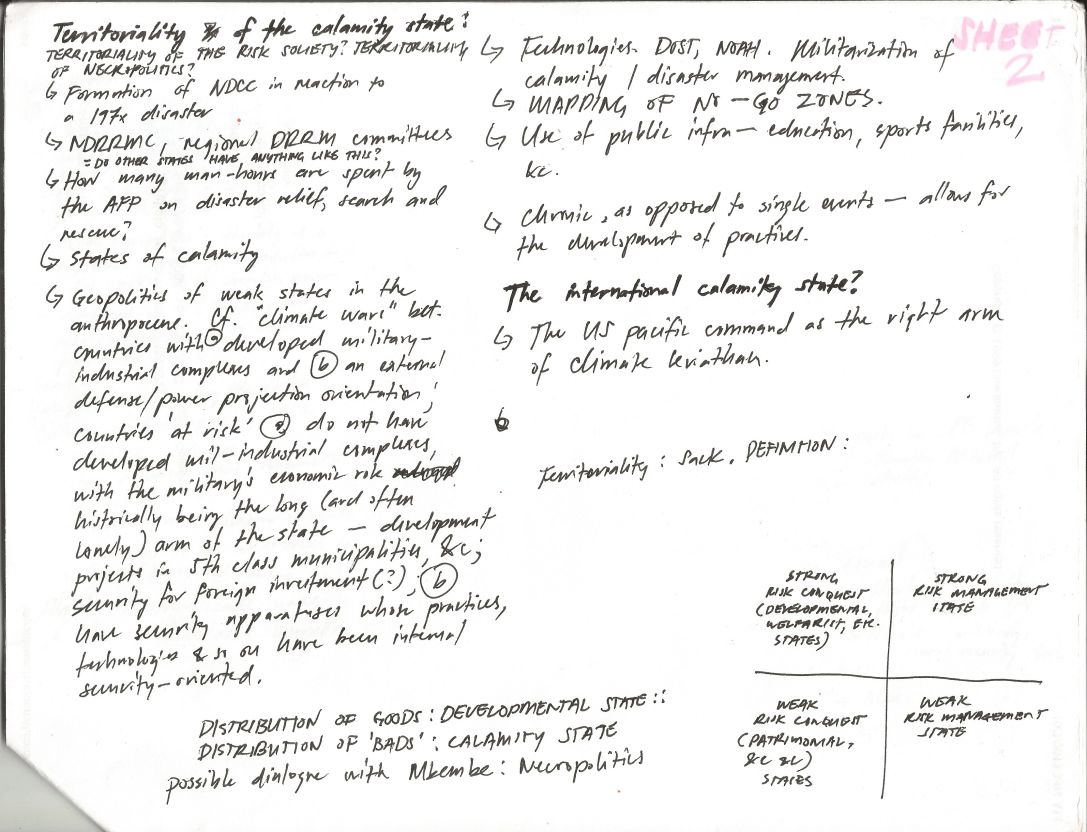
The states which exercise control over regions deemed at highest risk from climate change are, with a few exceptions, ‘weak’. In contrast to the great powers that are seen to be embroiled in climate wars, climate coloniality, or climate engineering, they do not have well-developed military-industrial complexes. They cannot project power far beyond their borders, and they have neither the personnel nor materiel to reshape the climate. Instead, their security apparatuses have historically been oriented toward internal threats, with a political-economic role limited to securing territories for ‘development’. But as complex emergencies become more important threats to these states, and as their militaries become embroiled in disaster response, resiliency efforts, and other operations other than war: how might practices initially developed to pacify unruly populations and to exert control over resources translate into new battlespaces involving environmental, public health, and urban planning risks?
This paper is an attempt at stating this question through the Philippines’ experiences with disasters in the early 21st century. Beginning with Typhoon Ondoy in 2009, and leading up to the Covid-19 pandemic, I consider how a ‘weak’ state exercised control over a ‘high-risk’ territory. I draw from Beck in framing 21st century complex disasters as embodying a shift from the first modernity of exploiting and distributing resources, to the second modernity of managing anthropogenic, catastrophic risks, and from Vandergeest and Peluso to conceptualize the state’s relationship with its land and people as a process of territorialization, a process which shapes the state’s practices of defining and controlling its territory. I propose that for the Philippine state, its reliance on militarized internal security operations to define and control the land and people within its territory, and on military personnel for staffing its civil works, environmental, and disaster management cabinet offices, had led it to rely on the personnel, rhetoric, and technologies of counterinsurgency to manage complex emergencies.

 Kenneth Cardenas