Embedded origins, unintended consequences
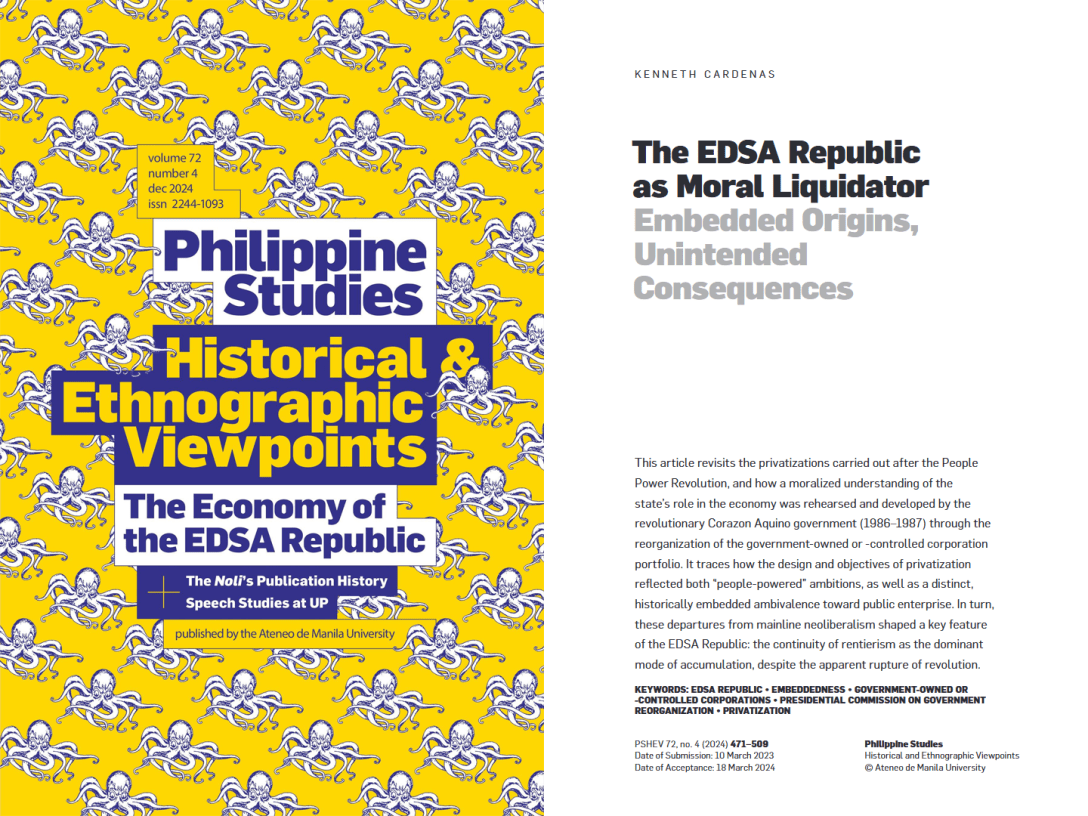
This article revisits the privatizations carried out after the People Power Revolution, and how a moralized understanding of the state’s role in the economy was rehearsed and developed by the revolutionary Corazon Aquino government (1986–1987) through the reorganization of the government-owned or -controlled corporation portfolio. It traces how the design and objectives of privatization reflected both “people-powered” ambitions, as well as a distinct, historically embedded ambivalence toward public enterprise. In turn, these departures from mainline neoliberalism shaped a key feature of the EDSA Republic: the continuity of rentierism as the dominant mode of accumulation, despite the apparent rupture of revolution.
This article appears in Vol. 72, no. 4 of Philippine Studies: Historical and Ethnographic Viewpoints. It builds on a chapter from my PhD dissertation, and from work I had presented at the 2024 Association for Asian Studies annual conference in Seattle, and the 5th Philippine Studies conference in Japan in 2022.
Access the full article through Project Muse here.
 Kenneth Cardenas
Insightful, nuanced, well-written–great article!
Thank you, Dr. Hau! What a pleasant surprise to hear from you. I am glad you liked it.
Just this past week I was rereading your 2014 article on epistemic power and authority. There’s a lot of resonances in it that I’d like to pick up, and I want to ask you some questions too. I’ll email soon.