For political imagination, and for varieties of possibility
Open file no. 50, began 24 October 2023
Sa sandaling matutunan mo ang managinip nang lubusang gising,
na ibalanse ang kamalayan hindi sa talim ng pangangatwiran
ngunit sa dobleng katig ng katwiran at panaginip;
sa sandaling matutunan mo ito,
mabibitawan mo lamang ito sa oras na mabitawan mo
kung paano magisip.
Ursula K. Le Guin, Ang Salita Para Sa Daigdig Ay Gubat
Ang tunay na radikal ay ang gawing abot-kamay ang pag-asa,
hindi ang patunayan ang pagka-gipit.
Raymond Williams
As I wrap up my dissertation, and as I take part in conversations about energy transitions, alternative transnational economies and solidarities, and climate crisis responses other than war, I have found myself turning and returning to two premises.
These arose as I came to my own understanding of how accumulation and class power had developed in the Philippines over five centuries of capitalist and colonial encounter.
I am finding, again and again, that many analytical categories that had developed in response to realities found elsewhere have very limited usefulness here.
This incongruency between concepts and realities is hinted at by the recurrent (evergreen?) mode of production debates within Philippine critical thought: is the Philippines a capitalist society, or is it semi-feudal, semi-colonial?
Maybe it is both and neither: the debate continues because both descriptions help explain some features of the systems we wish to describe and resist. Yet neither does justice to life as it arises within, alongside, and outside these systems.
If you and I agree, then we need to trace the reasons behind the poor conceptual fit.
These two premises also arose out of wanting to make hope possible, not despair convincing. I want to react to the rigid radicalism and damage-based research that I keep running into—and keep reproducing, myself.
If the whole point of ‘theory’ is ‘seeing’, I would much rather now learn ways of seeing that open up rather than foreclose political imagination. Instead of learning how to see lack, I would rather learn how to see varieties of possibility—especially in landscapes dismissed as wastelands.
If you and I agree, then we need to find a way to take part in conversations in a way that brings these abilities out—even among the most inflexible critical theory bores in our worlds.
Some rough, ongoing thoughts, under constant revision, shared here so we can pick up where we left off:
Premise 1.
No project of concentrating wealth or power in the Philippines, or involving the Philippines, has ever been total nor complete.
Empire had never been fully installed here. Its failures—and there are many—offer lessons.
Colonialism, imperialism, capitalism, authoritarian modernization, or neoliberal globalization: across five centuries of encounter, the Philippines had remained a far enough shore that distance modulates, dampens, occasionally even denies metropolitan designs.
The domestic market is too small, markets for its exports too distant, and the local resource base too small to justify intensification. Other colonies were integrated earlier or bound more tightly into their respective world-systems. There was less wealth to be made here, and it cost more to make it.
The landscape, nonhuman and human, is too fragmented and rugged and inscrutable, requiring too many layers of intermediation, brokerage, and associated costs of doing business, friction that no amount of adjustment, investment, or inducement could fully overcome.
And every project of concentrating wealth or power had been accompanied by a double movement. It is tempting to call this ‘resistance’ or ‘struggle’, yet plenty of schemes to pull the Philippines into closer coupling with Empire were thwarted by elite reactionaries. Just as importantly, both inertia and change can happen for the most prosaic reasons, without no clear correspondence between an explicit political agenda and material outcomes.
It might be weapons of the weak. It might be path-dependence. For now, place might be my best word for it: a pattern of life, irreducibly unique to a location, relationally created and reworked, that no scheme for improvement (or civilization, or conversion…) can ever fully undo.
Distance, friction, and emplaced agency mean the Philippines has managed to avoid the worst of each round of imperialism, and the worst unintended consequences of each round of modernity.
It was never a major destination for plantation capitalism. Capitalist sugar arrived relatively (thankfully) late, the investment was relatively miniscule, and—brought as it was by American and British interests—decoupled from the prevailing colonial state in Manila, itself weak, distant, and declining. Even as an American colony, most American investment in the region went to Singapore or China.
Even now, after five centuries of encounter, access to capital and enforcement of property rights remain a “problem” for rural development. The land and its peoples are so far incompletely and imperfectly yoked to debt markets and Torrens titles systems—to both banking and the state.
Settler-colonialism did not take root here the way it did elsewhere in the Spanish and American empires—not even in the form of a city-state enclave, despite Manila’s history as an entrepot; or of a garrison like Guam or Honolulu, despite Clark and Subic being the largest overseas US bases through much of the Cold War.
Manila’s own settler-colonial project in Mindanao was successfully resisted by the Moro peoples—at least, judged against other such nation-building schemes such as Indonesia’s transmigrasi, or Sri Lanka’s resettlement of Sinhala on Tamil lands.
Finally, postwar modernism here as complete nor as intense as it was elsewhere—despite being a laboratory for American imperial statecraft during the American century. From formal independence onward, it was closely bound to the designs of the US War Department, was under IMF supervision since the sixties, and became a casualty of World Bank-led attempts at export-oriented industrialization, and subsequently structural adjustment. Yet none of these plans, laid as they were by the strongest superpower, came to full fruition.
This is a recurring pattern to the Philippines’ relationship with, and position within, successive global political economies. Sketched briefly:
Despite sugar, Panay and Negros had not been transformed into the Caribbean.
Despite pineapple and banana, Mindanao had not been transformed into Hawaii or Central America.
Despite Bataan, Cavite, and Eastwood, the archipelago had not been transformed into an export processing zone.
Despite the Vietnam War, Domino Theory, Clark, Subic, and JUSMAG, the Philippines had not been transformed into a garrison state for the US Pacific Command.
The history of concentration of wealth and power in the Philippines might be more usefully told as a history of their failures than as a history of unending subjugation. And its geography might be better appreciated as one of fragmentation, not consolidation.
Premise 2.
No effort at resisting oppression in the Philippines, and creating conditions for flourishing, has ever been pure. Their repertoires had drawn from coercive, extractive, or oppressive schemes, and repurposed them for liberatory ends.
The role of folk, activist, or humanist Catholicisms in anticolonial, anti-authoritarian, environmental, and indigenous peoples’ struggles is the best-attested example of this tendency. But I want to illustrate it with something less intuitive, and hopefully more provocative—all the better to help with squinting.
I grew up in northern Quezon City. Urbanization here from the seventies is a patchwork of gated, privately-developed subdivisions and informal settlements, occasionally punctuated by national government edifices tracing to a failed high-modernist scheme for a planned capital.
The main radial road, Commonwealth Avenue, had been haphazardly widened from four to sixteen (or was it 22?) lanes through the late nineties into the 2000s, inducing demand into a chronic snarl. The cul-de-sac, car-owning subdivisions mostly empty out onto it; they allow no through traffic, and their bounds had pre-empted the secondary road network planned for the area.
The few feeder roads follow tortuous alignments, determined in part by the subdivisions’ property lines and in part by municipal road-widening projects. An elevated metro rail line is presently being built in the median by San Miguel Corporation, the largest Philippine-nationality conglomerate.
It is easy to call this landscape ‘neoliberal’, and one would not be wrong. It is a landscape of state retreat, privatized monopolies, sharp inequalities in wealth and well-being.
But the label also gets in the way of paying attention.
On both sides of Commonwealth Avenue are large parcels that, viewed from above, look suspiciously like forests. The largest, at 34 hectares, is larger than the Batasan Complex, and is only slightly smaller than the Balara Filtration Plant.
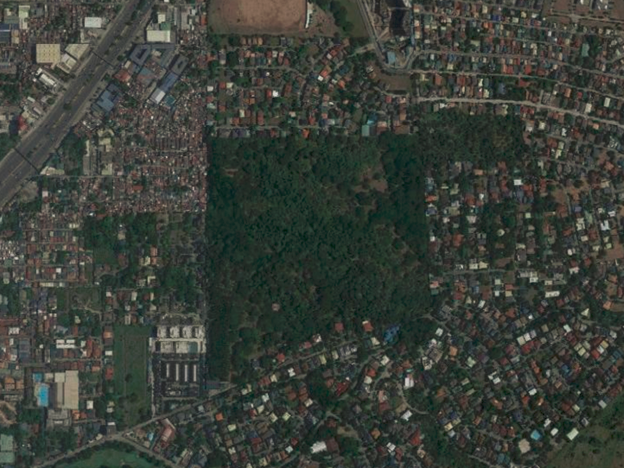
There are plenty of vacant lots in northern Quezon City, but not all vacant lots are like this. Inside the better-managed subdivisions, the idleness of lots—their readiness for sale or development—is actively policed by homeowners’ associations. Any growth that is too obvious, too wild is cut down. Fruit-bearing trees are singled out, as they might attract the wrong kind of people, and the wrong kind of conviviality; even guerrilla papayas tended by security guards and custodians are prohibited.
Then there are the lots, typically set aside for national government offices, that had undergone the ecological succession of many other Quezon City parcels: from unfunded modernist vision, to informal settlement, to criminalization of the community—and then maybe on to mass evictions and demolitions, or to some legal recognition of home, or to some incipient, insurgent possibility.
The lots that turn wild have a few things in common: they tend to not have easements on main roads and are hemmed in by previous rounds of development. They tend to be fenced in, hinting at some sort of active property claim, and the policing of settlement.
Finally, they also tend to be at some sort of limbo that liberates the land, for now, from highest and best use. The lot may be the subject of an active legal dispute. Or the owner might have a clear and consolidated title but is illiquid, and has no interest in selling.
In these situations, all claimants and the state have a shared interest in recognizing and enforcing the property line. But they do not have a shared interest in ‘developing’ the lot. In this manner, the tempo of accumulation, and of Manila’s utak semento urbanism, is interrupted.
Meanwhile, the lot becomes a refugium. Perhaps imperfect and fragmented, thus far unconnected by land or watercourses, amenable only to some birds, insects, and fruit-bearing trees. But one of many that actually exist, right now, alongside neoliberalism.
Rewilding, in other words, is being realized through the property form. Human self-interest creates spaces for non-human agency to flourish—and, possibly, open portals to a future Manila where the ground once more yields gently to the rain. The same institutions that produce immiseration also create non-convergent, non-deterministic varieties of possibility.
There is a recurrence in how some of the longest-lasting reservoirs of hope springs from these unlikely wells. It is easy to see this tendency everywhere, once you go about looking for it:
Nationalism, a romantic, European, bourgeois construct, was the grammar for a successful anticolonial revolt, and remains the basis for many strains of anti-imperialism and identity.
Competition among the country’s elites, in the main predatory and oligarchic, had created a space for a vibrant free press.
Some of the finest OPM of the 1990s and 2000s soundtracked TV station IDs and McDonald’s commercials. More generally, OPM and kundiman, vessels for some of the strongest strains of pop cultural militancy, drew from western idioms of rock and art music.
Labour export, a program initiated to generate foreign exchange for a dictatorship, has created a lifeline for rural households and livelihoods, opened spaces for the expression of gender freedoms, and—wherever overseas Filipinx organizing comes into contact with fellow Southern radicalisms—allowed for new nodes of solidarity to form.
Cooperativism, coupled closely with rural electrification and the modernization project, remains one of the most widespread, and most readily familiar, form of non-capitalist economic organization across the country.
UP, a legacy of American colonization, remains one of the strongest bastions of radicalism in the country.
The failures of the public education system, and the restrictiveness of sectarian private schools, creates gaps, and yearnings, for alternative learning to emerge.
More than a few of the country’s environmentalists have unlikely backgrounds in the extractive industries and the military.
And so on. Life, finding a way in the Philippines, has never cared too much for ideological purity.
 Kenneth Cardenas
Your about to wrap up your dissertation! Congratulations! I look forward to you sharing it to the world 🙂 J
Sent from Yahoo Mail for iPhone